
바카라사이트 온카판 개관
| 학습 기간 | 2017 - 2030 |
| 산정기준연도 | 2024 |
| 예측 데이터 기간 | 2025 - 2030 |
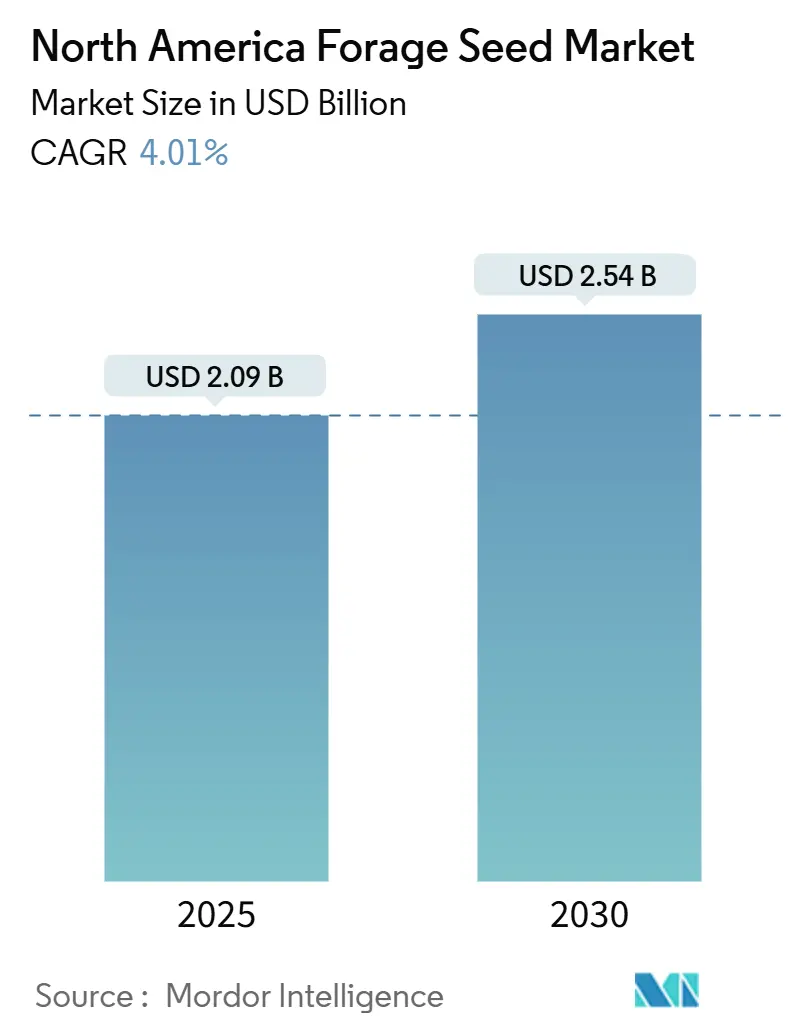
| 바카라사이트 온카판 규모(2025년) | USD 2.09 십억 |
| 바카라사이트 온카판 규모(2030년) | USD 2.54 십억 |
| 성장률(2025년~2030년) | 4.01 % CAGR |
| 시장 집중 | 높음 |
주요 선수
*면책조항: 주요 플레이어는 특별한 순서 없이 정렬되었습니다. 이미지 © 바카라 사이트. 재사용 시 CC BY 4.0에 따라 저작자 표시가 필요합니다. |
|
North America Forage Seed Market Analysis by 바카라 사이트
The North America forage seed market size reached USD 2.09 billion in 2025 and is forecast to climb to USD 2.54 billion by 2030, advancing at a 4.01% CAGR over the period. A steady surge in livestock inventories, rapid commercialization of drought-tolerant genetics, and widening e-commerce access underpin a growth pattern that remains resilient in the face of weather volatility. Seed companies are channeling capital into biotechnology and microbial coatings that elevate germination on marginal soils, helping producers squeeze more protein per acre while managing water scarcity. Cost-share incentives from federal and provincial agencies lower the adoption hurdle for premium varieties while online channels shorten the supply chain, enabling small and mid-size farmers to source specialized genetics once reserved for large corporate dairies. Competitive intensity is shifting away from price and toward trait innovation, with patent filings for drought tolerance, digestibility, and herbicide resistance accelerating as climate risk mounts.
주요 바카라 요약
- By breeding technology, hybrids held 64.4% of the North America forage seed market share in 2024; open-pollinated varieties and hybrid derivatives are expanding at a 4.54% CAGR through 2030.
- By crop type, other forage crops accounted for 79.3% share of the North America forage seed market size in 2024, while alfalfa is growing the fastest at a 4.52% CAGR to 2030.
- By geography, Canada captured 47.6% revenue share in 2024 and is advancing at a 5.12% CAGR to 2030, the quickest pace among all countries.
North America Forage Seed Market Trends and Insights
드라이버 영향 분석
| 운전기사 | (~) CAGR 예측에 미치는 영향 | 지리적 관련성 | 영향 타임라인 |
|---|---|---|---|
| Expansion of dairy and beef livestock herds boosts demand for high-protein forage seed | 0.8% | United States, Canada core with spillover to Mexico | 중기(2~4년) |
| Shift toward drought-tolerant pasture systems amid rising water-stress events | 0.7% | Western United States, Prairie Canada, and Northern Mexico | 장기 (≥ 4년) |
| Broad adoption of GM herbicide-tolerant alfalfa and sorghum hybrids | 0.6% | United States, selective adoption in Canada | 단기 (≤ 2년) |
| Government cost-share programs for cover-crop/forage establishment | 0.5% | United States through USDA programs, Canada through provincial initiatives | 중기(2~4년) |
| Rapid growth of e-commerce seed channels reaching small and mid-size producers | 0.4% | North America with rural connectivity improvements | 단기 (≤ 2년) |
| Venture-capital–backed microbial seed coatings improving establishment on marginal soils | 0.3% | North America, with a focus on degraded agricultural lands | 장기 (≥ 4년) |
출처: 모르도르 정보
Expansion of Dairy and Beef Herds Boosts Demand for High-Protein Forage Seed
Livestock inventory expansion across North America drives fundamental demand shifts toward protein-dense forage varieties that optimize feed conversion ratios and milk production yields. The United States Department of Agriculture (USDA) data indicate that dairy cow numbers increased 2.1% in 2024, while beef cattle operations expanded by 1.8%, creating sustained pressure for premium forage genetics[1]Source: USDA National Agricultural Statistics Service, “Livestock and Poultry Statistics,” nass.usda.gov. Because land prices keep climbing, many producers maximize nutrients per acre with elite seed genetics that furnish crude-protein levels above 20%. Organic operators face extra pressure to source certified seed, channeling more value into specialty suppliers. The North America forage seed market benefits as feedlots and dairies commit to multi-year genetics contracts to lock in supply and hedge against price swings.
Shift Toward Drought-Tolerant Pasture Systems Amid Rising Water-Stress Events
Roughly 35% of regional grasslands endured severe drought during the 2024 season, accelerating grower migration to deep-rooted alfalfa and water-efficient sorghum that retain up to 70% of anticipated yield under stress[2]Source: National Drought Mitigation Center, “North American Drought Monitor,” droughtmonitor.unl.edu. Adoption dovetails with precision irrigation programs that ration every acre-inch of water. Insurance premium discounts now reward producers who verify resilient varieties, enhancing the economic case for upgrading genetics. Seed developers respond by stacking drought tolerance with improved digestibility, a combination proving attractive to both cattle and sheep operations where weight-gain targets remain stringent.
Broad Adoption of GM Herbicide-Tolerant Alfalfa and Sorghum Hybrids
Biotechnology integration transforms weed management protocols while reducing labor costs and chemical inputs for large-scale forage operations. Herbicide-tolerant alfalfa adoption reached 85% of total alfalfa acreage in the United States by 2024, driven by glyphosate resistance that enables post-emergence weed control without crop damage. The same trend is moving into forage sorghum, where dual-trait hybrids curb broadleaf pressure and reduce chemical expenditure by up to 25%. Trait uptake is slower in Canada because of tighter regulatory reviews, but cross-border seed flows ensure availability for early adopters. As resistant weeds proliferate, tolerance traits become less a luxury and more a risk-management necessity, anchoring recurring demand for proprietary genetics.
Government Cost-Share Programs for Cover-Crop and Forage Establishment
Federal and state conservation programs provide financial incentives that reduce establishment costs and accelerate adoption of improved forage systems among cost-sensitive producers. The USDA Conservation Reserve Program allocated USD 1.8 billion in 2024 for cover crop and forage establishment, with average cost-share rates of 50-75% for approved seed varieties[3]Source: USDA Farm Service Agency, “Conservation Reserve Program Statistics,” fsa.usda.gov. Parallel provincial grants in Alberta and Saskatchewan further lower upfront spending, letting small family farms trial hybrid blends they previously considered unaffordable. Compliance rules mandate certified seed and documented establishment, pushing sales toward licensed suppliers with audit-ready traceability systems. That in turn shapes breeding pipelines by favoring varieties that meet environmental scoring metrics tied to soil-carbon retention and pollinator benefits.
제약 영향 분석
| 제지 | (~) CAGR 예측에 미치는 영향 | 지리적 관련성 | 영향 타임라인 |
|---|---|---|---|
| Extreme climate volatility is causing seed-crop production swings | -0.6 % | North America with particular impact on seed production regions | 단기 (≤ 2년) |
| IP-driven seed price escalation is limiting adoption by forage hay growers | -0.4 % | United States and Canada with patent-protected varieties | 중기(2~4년) |
| Emerging herbicide resistance in forage sorghum and grass pastures | -0.3 % | United States Great Plains, Canadian Prairies | 장기 (≥ 4년) |
| Tight native seed supply as prairie restoration accelerates | -0.2 % | Great Plains region, Prairie Canada | 중기(2~4년) |
출처: 모르도르 정보
Extreme Climate Volatility Causing Seed-Crop Production Swings
Weather extremes increasingly disrupt seed production schedules and quality standards, creating supply chain instability that constrains market growth and inflates pricing volatility. The 2024 growing season experienced record temperature fluctuations across key seed production regions, with North Dakota reporting a 35% reduction in alfalfa seed yields due to late-season frost events. Similar episodes of excessive heat during pollination lowered germination quality, prompting rigorous new QC protocols. Insurers raised seed-crop coverage premiums, costs that flow downstream to end-users. Multi-regional production helps buffer supply but increases logistical complexity and inventory holding risk.
IP-Driven Seed Price Escalation Limiting Adoption by Forage Hay Growers
Intellectual property protection for advanced genetics creates pricing premiums that exceed economic thresholds for many forage hay operations, particularly those serving commodity markets with limited pricing flexibility. Patent-protected alfalfa varieties command price premiums over conventional genetics, while licensing fees for herbicide-tolerant traits add additional costs that many producers cannot justify given current hay pricing. The situation intensifies as patent portfolios expand and trait stacking increases licensing complexity, with some advanced varieties requiring multiple royalty payments that compound cost pressures. Legal frameworks governing seed patents also create uncertainty for producers regarding saved seed usage rights, further complicating adoption decisions and potentially constraining market growth in price-sensitive 세그먼트.
세그먼트 분석
By Breeding Technology: Hybrids Maintain Scale Advantage While Diversity Gains Appeal
Hybrid cultivars accounted for 64.4% of the North America forage seed market share in 2024, underlining their status as the performance benchmark for large dairies and feedlots. Yield consistency, uniform maturity, and built-in trait packages such as herbicide tolerance and digestibility enhancement keep hybrids dominant. The North America forage seed market has seen continuous trait stacking, moving beyond weed control into drought endurance and protein boost, a progression that aligns with precision-nutrition goals. Yet open-pollinated varieties and hybrid derivatives are outpacing the category at a 4.54% CAGR, a trend reflective of cost containment and organic certification needs. Smaller ranches value the ability to save seed without infringing patents, and diversified grass-fed systems prize the genetic heterogeneity that buffers climatic shocks.
Open-pollinated expansion creates room for regional seed houses that curate locally adapted germplasm, sometimes pairing non-GM genetics with microbial coatings for better emergence on depleted soils. These entrants rarely challenge the R&D budgets of multinationals, but they secure loyalty in niche channels that transact heavily online. The hybrid camp counters by releasing lower-royalty “value” lines and introducing digital agronomy tools that fine-tune seeding rates and fertility, elevating return on every bag sold. As intellectual property regimes evolve, both models appear poised to coexist, with hybrids anchoring volume and open-pollinated types supplying flexibility within the broader North America forage seed market.
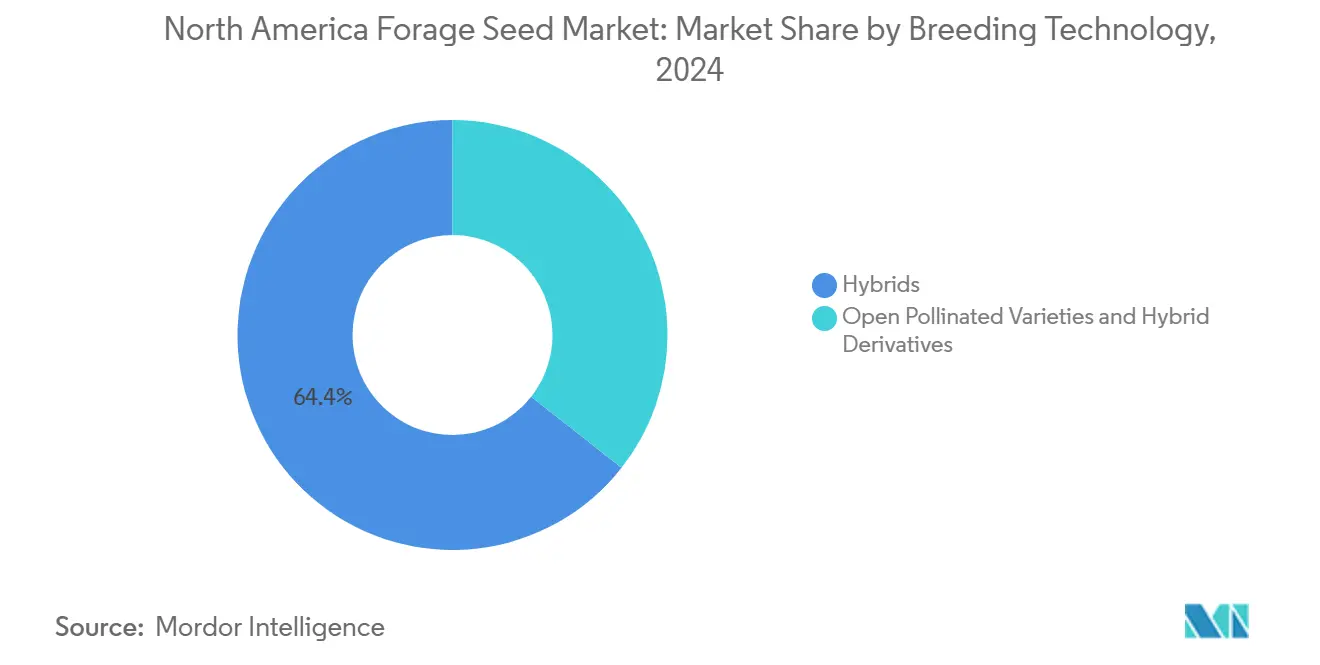
참고: 바카라 구매 시 사용 가능한 모든 개별 세그먼트의 세그먼트 공유
By Crop Type: Diverse Forage Blends Dominate as Alfalfa Accelerates
Other Forage Crops represented 79.3% of the North America forage seed market size in 2024, illustrating producer preference for agronomic resilience and soil-health gains. Ryegrass-clover blends, meadow brome, and chicory combos gain traction in regenerative grazing programs where biomass diversity extends grazing seasons and cuts input dependence. Seed firms now package multi-species cocktails pre-formulated for regional rainfall and soil pH, an approach resonating with conservation cost-share metrics.
Alfalfa, while a smaller slice, is expanding fastest at a 4.52% CAGR, supported by its unrivaled protein contribution to dairy rations. Breeders leverage genomics to boost digestibility and lignin reduction, enabling higher milk yields per ton of dry matter. Forage sorghum is carving out gains in low-water environments; its seed demand correlates tightly with irrigation-cut mandates in the Ogallala aquifer zone. Forage corn maintains presence in high-nutrition diets but faces competition from sorghum where water rights tighten. Altogether, crop-type momentum underscores a wider shift in the North America forage seed market toward biologically-diverse swards that better withstand climate volatility.

지리 분석
Canada delivered 47.6% of total revenue in 2024, making it the single largest slice of the North America forage seed market. Strong provincial incentives for pasture renovation, a consolidated dairy sector, and extensive prairie acreage converge to fuel volume. The North America forage seed market size, attributed to Canada, is expanding at a 5.12% CAGR, propelled by accelerated adoption of drought-tolerant blends as prairie summers grow hotter. Seed orders align with cost-share windows, creating predictable spring and fall surges that suppliers must stock months in advance.
The United States follows in absolute value terms; its sheer production diversity stretches from temperate Midwest hayfields to humid Southeast grass pastures. Federal conservation dollars and a robust e-commerce ecosystem support varietal experimentation, yet growth lags in Canada because of market maturity. Mexico remains a nascent but noteworthy frontier. Modernizing dairies in Chihuahua and Jalisco are trialing North American genetics, but constraints in cold-storage logistics and financing slow broader uptake. The rest of North America contributes marginally today but represents latent upside as infrastructure and rural credit access improve.
Mexico’s market is anchored in northern dairy belts where modern confinement systems crave protein-rich hay. Imports of elite alfalfa seed from suppliers in Arizona and California rise annually despite logistics bottlenecks at border warehouses. Pilot government programs now test subsidy models similar to Canadian cost-share schemes but have yet to reach scale. Longer term, improvements in cold-chain trucking and broader fintech penetration are likely to unleash pent-up demand, broadening the geographic footprint of the North America forage seed market.
경쟁 구도
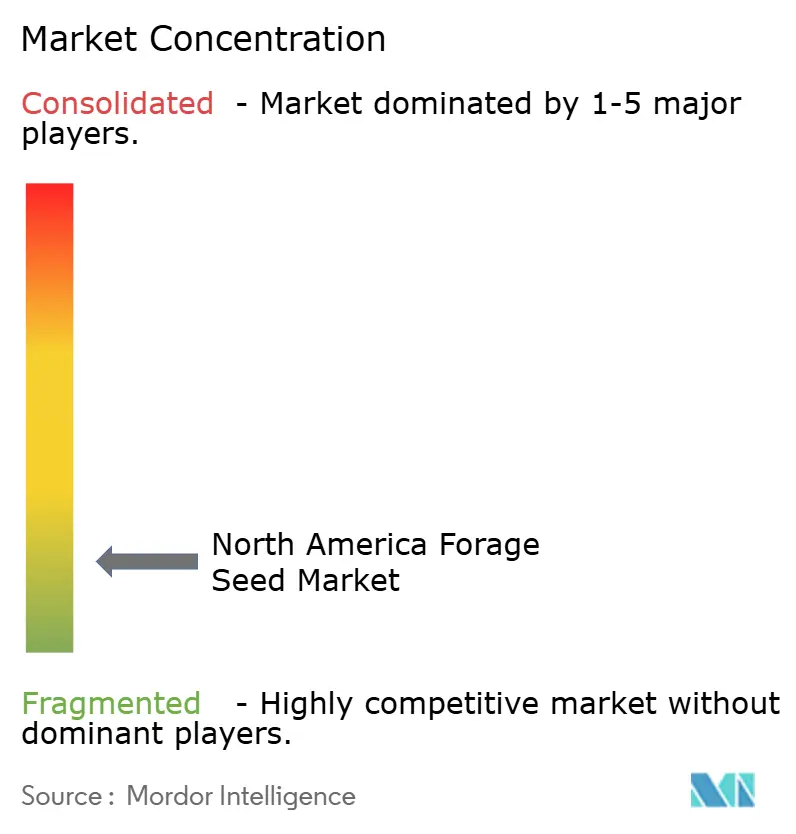
The North America forage seed market shows a fragmented structure. The top five multinational companies control a minimum share of revenue, enough to exert scale benefits but leaving room for niche entrepreneurs. Bayer AG made substantial investments in new North Dakota and Alberta plants to secure drought-tolerant alfalfa processing capacity, a move that widens the distance from smaller rivals in volume-based contract bids.
Digital disruptors, including Allied Seed and Hancock Seed, are leveraging direct-to-consumer storefronts and subscription models to chip away at regional dealer share. They often bundle microbial coatings and provide localized agronomy dashboards, differentiators that resonate with tech-savvy millennial farmers. Meanwhile, European breeders such as DLF Seeds and KWS SAAT partner with North American biotech start-ups for next-generation trait development, indicating an ecosystem that values collaborative innovation over zero-sum rivalry. Patent races continue; applications tied to drought tolerance, underscoring the strategic centrality of climate adaptation.
Regulatory developments remain a swing factor. Canada’s stricter biotech approval timelines slow cross-border trait harmonization, so multinationals stagger product launches, first entering the United States and later Canada. This sequencing forces distributors to manage dual inventories. Moderate consolidation, paired with expanding specialty niches, signals a competitive scene where both scale and specialization can thrive within the North America forage seed market.
North America Forage Seed Industry Leaders
-
바이엘 AG
-
KWS SAAT SE & Co. KGaA
-
Land O'Lakes Inc.
-
DLF 씨앗 A/S
-
코르테바
- *면책조항: 주요 플레이어는 특별한 순서 없이 정렬되었습니다.
바카라사이트 온카판 참가자 및 경쟁사에 대한 자세한 정보가 필요하십니까?
PDF 다운로드
최근 산업 발전
- June 2025: DLF Seeds A/S launched a new corporate strategy in June 2025, focusing on sustainability through seed enhancement development. The company invested in seed enhancement facilities and proprietary technology to develop seed coatings with biological and nutritional components.
- August 2022: DLF established a research station dedicated to forage, turf, and legumes across a 30-acre facility in Bangor, Wisconsin.
이 바카라를 사용하면 무료
우리는 업계의 기본 구조를 나타내는 지역 및 국가 수준 지표에 대한 포괄적이고 포괄적인 데이터 포인트 세트를 무료로 제공합니다. 90개 이상의 무료 차트 형식으로 제공되는 이 섹션은 범위 내 다양한 작물의 재배 면적에 관해 다양한 지역의 찾기 어려운 데이터를 다룹니다.
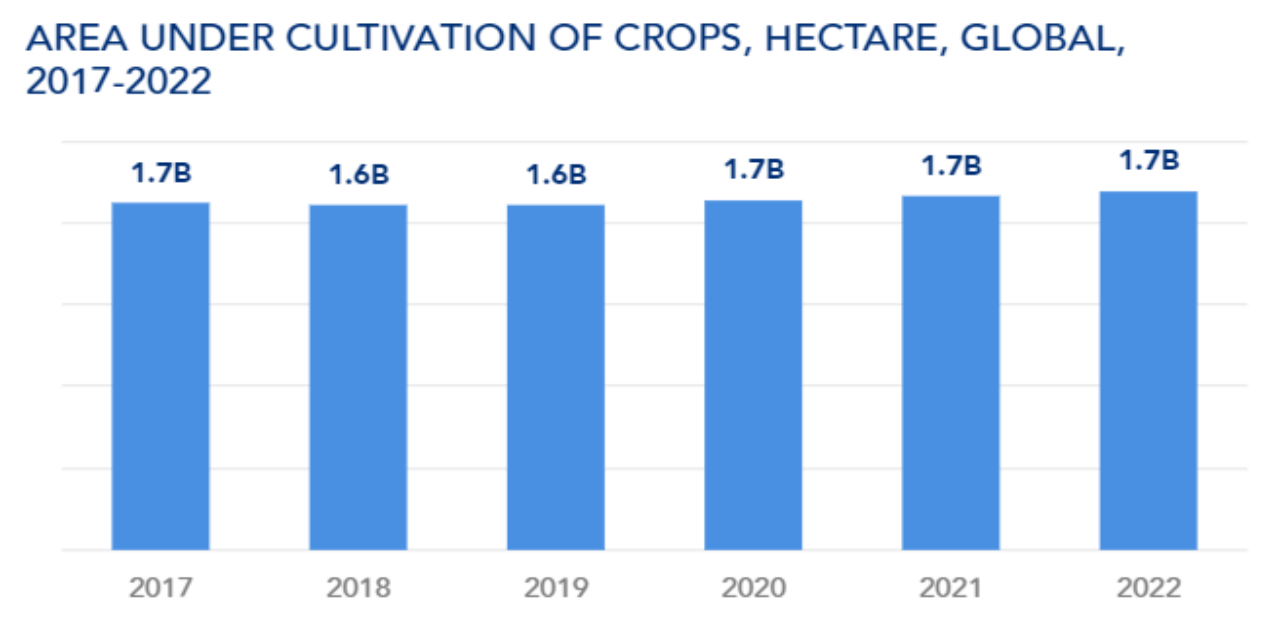
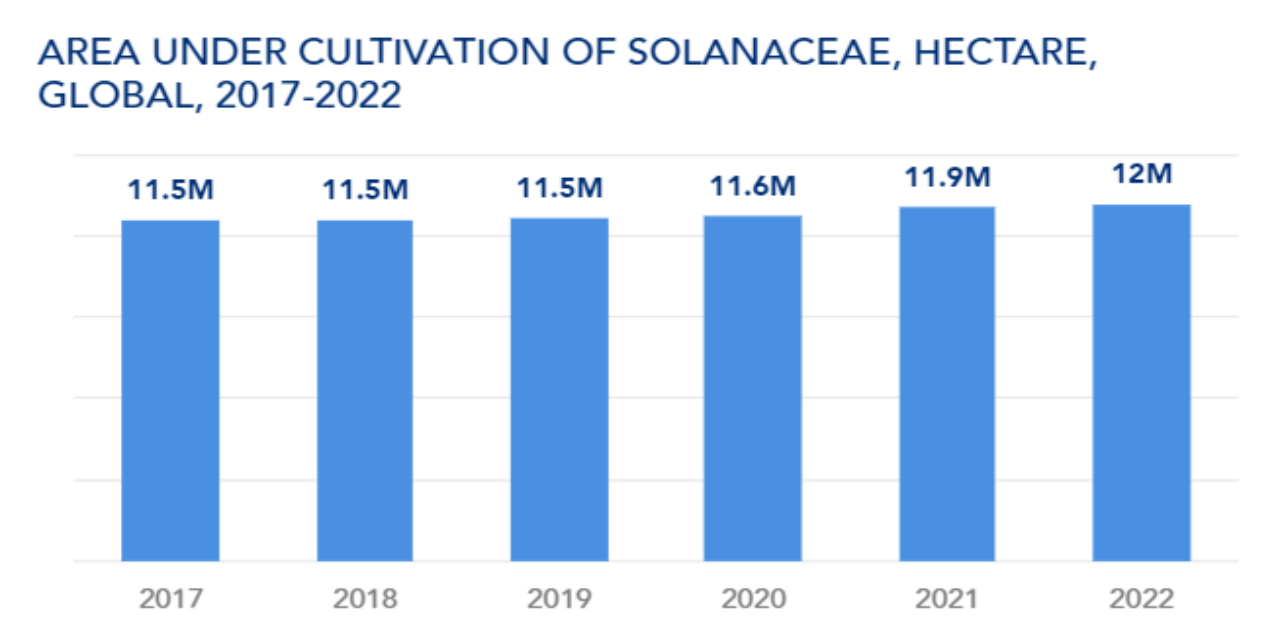
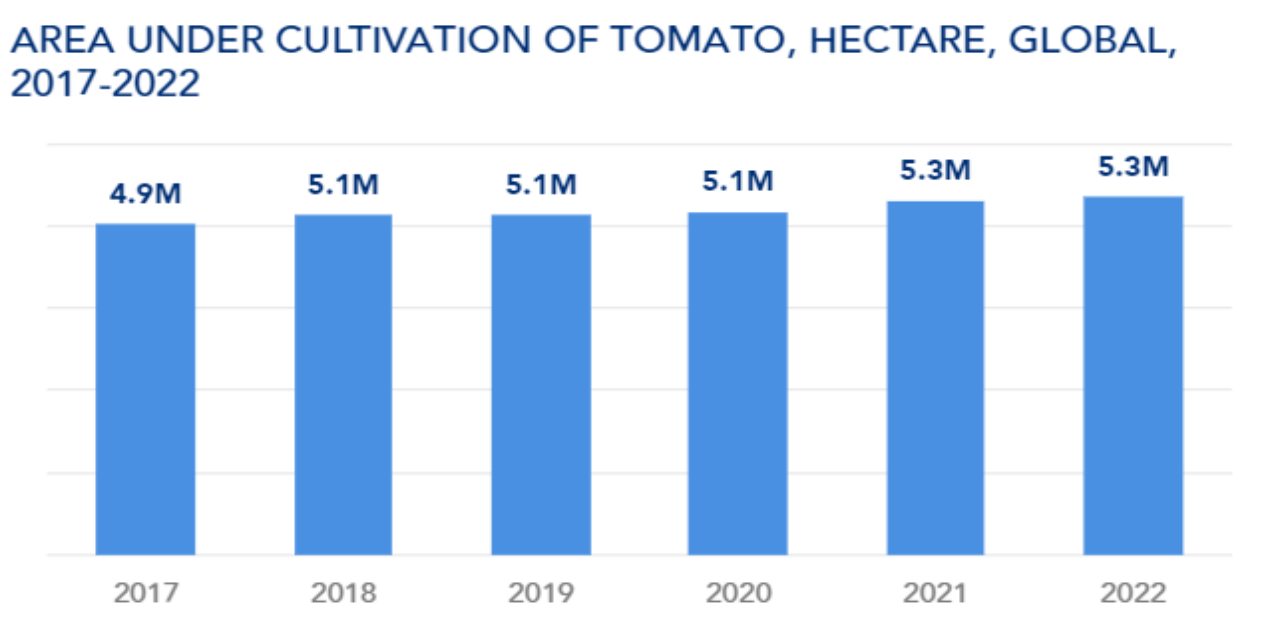
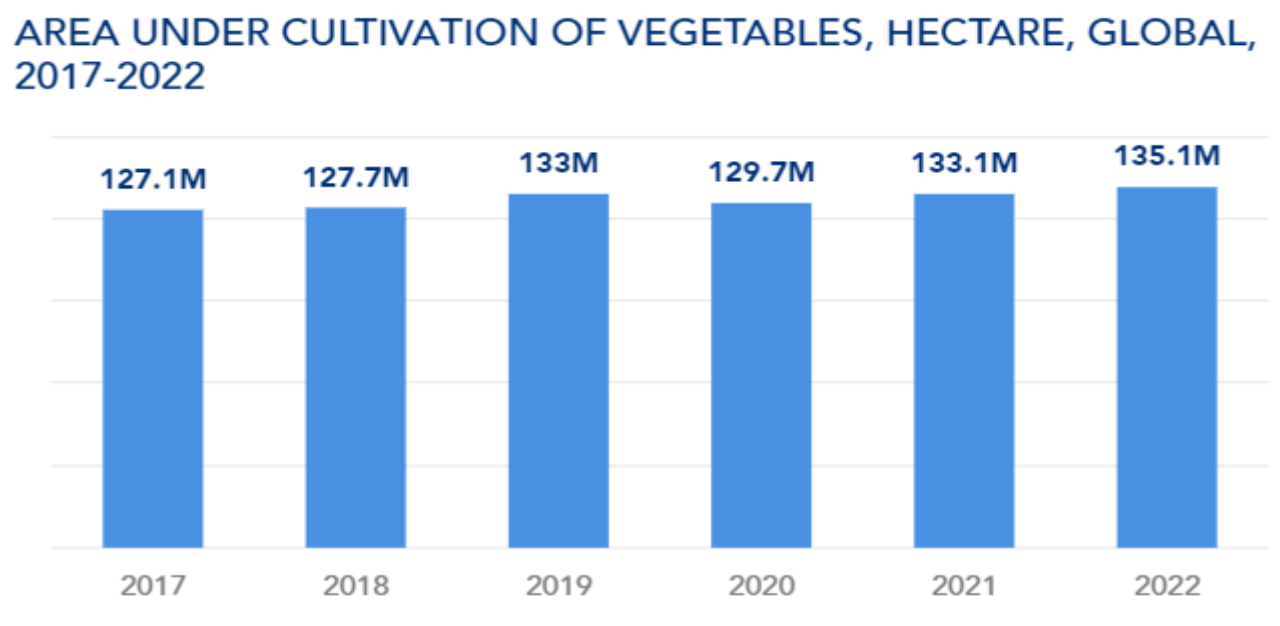
표 및 그림 목록
- 그림 1 :
- 행 작물 재배 면적, 헥타르, 북미, 2017-2022
- 그림 2 :
- 주요 알파파 특성의 가치 점유율, %, 북미, 2022
- 그림 3 :
- 행 작물 육종 기술의 가치 점유율, %, 북미, 2022
- 그림 4 :
- 마초 작물 바카라사이트 온카판의 양, 미터톤, 북미, 2017년 - 2030년
- 그림 5 :
- 마초 작물 바카라사이트 온카판의 가치, USD, 북미, 2017 - 2030
- 그림 6 :
- 사육 기술 범주별 마초 작물 바카라사이트 온카판의 양, 미터톤, 북미, 2017년 - 2030년
- 그림 7 :
- 사육 기술 범주별 마초 작물 바카라사이트 온카판의 가치, 미국 달러, 북미, 2017년 - 2030년
- 그림 8 :
- 육종 기술 범주별 마초 작물 바카라사이트 온카판의 양 점유율, %, 북미, 2017 VS 2023 VS 2030
- 그림 9 :
- 육종 기술 범주별 마초 작물 바카라사이트 온카판의 가치 점유율, %, 북미, 2017 VS 2023 VS 2030
- 그림 10 :
- 잡종 카테고리별 마초 작물 바카라사이트 온카판의 양, 미터톤, 북미, 2017년 - 2030년
- 그림 11 :
- 잡종 카테고리별 마초 작물 바카라사이트 온카판의 가치, 미국 달러, 북미, 2017년 - 2030년
- 그림 12 :
- 잡종 카테고리별 마초 작물 바카라사이트 온카판의 양 점유율, %, 북미, 2017 VS 2023 VS 2030
- 그림 13 :
- 잡종 카테고리별 마초 작물 바카라사이트 온카판의 가치 점유율, %, 북미, 2017 VS 2023 VS 2030
- 그림 14 :
- 비형질전환 잡종 마초 작물 바카라사이트 온카판의 양, 미터톤, 북미, 2017년 - 2030년
- 그림 15 :
- 비형질전환 잡종 마초 작물 바카라사이트 온카판의 가치, 미국 달러, 2017년 - 2030년
- 그림 16 :
- 작물별 비형질전환 잡종 마초 작물 바카라사이트 온카판의 가치 점유율(%), 북미, 2023년 및 2030년
- 그림 17 :
- 형질전환 잡종 카테고리별 마초 작물 바카라사이트 온카판의 양, 미터톤, 북미, 2017년 - 2030년
- 그림 18 :
- 형질전환 잡종 카테고리별 마초 작물 바카라사이트 온카판의 가치, 미국, 북미, 2017년 - 2030년
- 그림 19 :
- 형질전환 잡종 카테고리별 마초 작물 바카라사이트 온카판의 양 점유율, %, 북미, 2017 VS 2023 VS 2030
- 그림 20 :
- 형질전환 잡종 카테고리별 마초 작물 바카라사이트 온카판의 가치 점유율, %, 북미, 2017 VS 2023 VS 2030
- 그림 21 :
- 제초제 내성 잡종 마초 작물 바카라사이트 온카판의 양, 미터톤, 북미, 2017년 - 2030년
- 그림 22 :
- 제초제 내성 잡종 마초 작물 바카라사이트 온카판의 가치, 미국 달러, 2017~2030년
- 그림 23 :
- 제초제 내성 잡종 마초 작물 바카라사이트 온카판의 작물별 가치 점유율(%), 북미, 2023년 및 2030년
- 그림 24 :
- 기타 특성 마초 작물 바카라사이트 온카판의 양, 미터톤, 북미, 2017년 - 2030년
- 그림 25 :
- 기타 특성 마초 작물 바카라사이트 온카판의 가치, USD, 북미, 2017 - 2030
- 그림 26 :
- 작물별 기타 특성 마초 작물 바카라사이트 온카판의 가치 점유율, %, 북미, 2023년 및 2030년
- 그림 27 :
- 개방 수분 품종 및 잡종 파생 상품 마초 작물 바카라사이트 온카판의 양, 미터톤, 북미, 2017년 - 2030년
- 그림 28 :
- 개방 수분 품종 및 잡종 파생 상품 마초 작물 바카라사이트 온카판의 가치, 미국 달러, 북미, 2017 - 2030
- 그림 29 :
- 작물별 개방 수분 품종 및 잡종 파생 상품 마초 작물 바카라사이트 온카판의 가치 점유율(%), 북미, 2023년 및 2030년
- 그림 30 :
- 작물 카테고리별 마초 작물 바카라사이트 온카판량, 미터톤, 북미, 2017년 - 2030년
- 그림 31 :
- 작물 카테고리별 마초 작물 바카라사이트 온카판의 가치, 미국 달러, 북미, 2017년 - 2030년
- 그림 32 :
- 작물 카테고리별 마초 작물 바카라사이트 온카판의 양 점유율, %, 북미, 2017 VS 2023 VS 2030
- 그림 33 :
- 작물 카테고리별 마초 작물 바카라사이트 온카판의 가치 점유율, %, 북미, 2017 VS 2023 VS 2030
- 그림 34 :
- 알파파 바카라사이트 온카판량, 미터톤, 북미, 2017년 - 2030년
- 그림 35 :
- 자주개자리 바카라사이트 온카판의 가치, 미국 달러, 북미, 2017년 - 2030년
- 그림 36 :
- 번식 기술별 알팔파 바카라사이트 온카판의 가치 점유율, %, 북미, 2023년 및 2030년
- 그림 37 :
- 마초 옥수수 바카라사이트 온카판의 양, 미터톤, 북미, 2017년 - 2030년
- 그림 38 :
- 마초 옥수수 바카라사이트 온카판의 가치, 미국 달러, 북미, 2017 - 2030
- 그림 39 :
- 육종 기술별 마초 옥수수 바카라사이트 온카판의 가치 점유율, %, 북미, 2023년 및 2030년
- 그림 40 :
- 마초 수수 바카라사이트 온카판의 양, 미터톤, 북미, 2017년 - 2030년
- 그림 41 :
- 마초 수수 바카라사이트 온카판의 가치, 미국 달러, 북미, 2017년 - 2030년
- 그림 42 :
- 육종 기술에 따른 마초 수수 바카라사이트 온카판의 가치 점유율, %, 북미, 2023년 및 2030년
- 그림 43 :
- 기타 마초 작물 바카라사이트 온카판의 양, 미터톤, 북미, 2017년 - 2030년
- 그림 44 :
- 기타 마초 작물 바카라사이트 온카판의 가치, USD, 북미, 2017 - 2030
- 그림 45 :
- 육종 기술에 따른 기타 마초 작물 바카라사이트 온카판의 가치 점유율, %, 북미, 2023년 및 2030년
- 그림 46 :
- 국가별 마초 작물 바카라사이트 온카판량, 미터톤, 북미, 2017년 - 2030년
- 그림 47 :
- 국가별 마초 작물 바카라사이트 온카판의 가치, 미국 달러, 북미, 2017년 - 2030년
- 그림 48 :
- 국가별 마초 작물 바카라사이트 온카판의 양 점유율, %, 북미, 2017 VS 2023 VS 2030
- 그림 49 :
- 국가별 마초 작물 바카라사이트 온카판의 가치 점유율, %, 북미, 2017 VS 2023 VS 2030
- 그림 50 :
- 캐나다 마초 작물 바카라사이트 온카판량, 미터톤, 북미, 2017년 - 2030년
- 그림 51 :
- 캐나다 마초 작물 바카라사이트 온카판의 가치, USD, 북미, 2017 - 2030
- 그림 52 :
- 작물별 캐나다 마초 작물 바카라사이트 온카판의 가치 점유율, %, 북미, 2023년 및 2030년
- 그림 53 :
- 멕시코 마초 작물 바카라사이트 온카판량, 미터톤, 북미, 2017년 - 2030년
- 그림 54 :
- 멕시코 마초 작물 바카라사이트 온카판의 가치, USD, 북미, 2017 - 2030
- 그림 55 :
- 작물별 멕시코 마초 작물 바카라사이트 온카판의 가치 점유율(%), 북미, 2023년 및 2030년
- 그림 56 :
- 2017년 - 2030년 미국 마초 작물 바카라사이트 온카판량, 미터톤, 북미
- 그림 57 :
- 미국 마초 작물 바카라사이트 온카판의 가치, USD, 북미, 2017 - 2030
- 그림 58 :
- 작물별 미국 마초 작물 바카라사이트 온카판의 가치 점유율(%), 북미, 2023년 및 2030년
- 그림 59 :
- 북미 나머지 지역 마초 작물 바카라사이트 온카판의 양, 미터톤, 북미, 2017년 - 2030년
- 그림 60 :
- 북미 나머지 지역 마초 작물 바카라사이트 온카판의 가치, USD, 북미, 2017 - 2030
- 그림 61 :
- 북미 나머지 지역 작물별 마초 작물 바카라사이트 온카판의 가치 점유율(%, 북미, 2023년 및 2030년)
- 그림 62 :
- 2017-2023년 북미 지역의 전략적 움직임 횟수로 가장 활발한 기업
- 그림 63 :
- 가장 많이 채택된 전략, 백작, 북미, 2017-2023
- 그림 64 :
- 주요 플레이어의 가치 점유율, %, 북미
North America Forage Seed Market Report Scope
잡종, 개방 수분 품종 및 잡종 파생물은 육종 기술에 의해 세그먼트로 다루어집니다. 알팔파, 사료용 옥수수, 사료용 수수는 작물에 의해 세그먼트로 다루어집니다. 캐나다, 멕시코, 미국은 국가에 의해 세그먼트로 다루어집니다.| 번식 기술 | 하이브리드 | 비형질전환 잡종 | ||
| 트랜스제닉 하이브리드 | 제초제 내성 잡종 | |||
| 기타 특성 | ||||
| 개방 수분 품종 및 잡종 파생물 | ||||
| 자르기 유형 | Alfalfa | |||
| 마초 옥수수 | ||||
| 마초 수수 | ||||
| 기타 마초 작물 | ||||
| 국가 | Canada | |||
| Mexico | ||||
| United States | ||||
| 북미의 나머지 | ||||
번식 기술
| 하이브리드 | 비형질전환 잡종 | ||
| 트랜스제닉 하이브리드 | 제초제 내성 잡종 | ||
| 기타 특성 | |||
| 개방 수분 품종 및 잡종 파생물 | |||
자르기 유형
| Alfalfa |
| 마초 옥수수 |
| 마초 수수 |
| 기타 마초 작물 |
국가
| Canada |
| Mexico |
| United States |
| 북미의 나머지 |
다른 지역이나 세그먼트가 필요하신가요?
지금 사용자 정의
바카라사이트 온카판 정의
- 상업용 바카라사이트 온카판 - 이 연구의 목적을 위해 상업용 종자만 범위의 일부로 포함되었습니다. 상업적으로 라벨이 붙지 않은 농장에서 보관한 종자는 농장에서 보관한 종자의 소수가 농부들 사이에서 상업적으로 교환되더라도 범위에서 제외됩니다. 또한 범위에서는 바카라사이트 온카판에서 상업적으로 판매될 수 있는 무성생식 작물과 식물 부분도 제외됩니다.
- 작물 면적 - 재배면적 산정시 총경작면적을 고려하였습니다. FAO(Food & Agricultural Organization)에 따르면 수확 면적이라고도 하며 계절에 따라 특정 작물로 경작되는 총 면적이 포함됩니다.
- 바카라사이트 온카판 대체율 - 바카라사이트 온카판대체율은 농가에서 저장한 바카라사이트 온카판가 아닌 인증된 품질의 바카라사이트 온카판를 사용하여 그 계절에 파종된 작물의 총면적 중 파종면적의 비율이다.
- 보호 재배 - 바카라는 보호 재배를 통제된 환경에서 작물을 재배하는 과정으로 정의합니다. 여기에는 온실, 온실, 수경재배, 수경재배 또는 비생물적 스트레스로부터 작물을 보호하는 기타 재배 시스템이 포함됩니다. 그러나 플라스틱 덮개를 사용하여 노지에서 재배하는 것은 이 정의에서 제외되며 노지 아래에 포함됩니다.
| 키워드 | 정의 |
|---|---|
| 줄 자르기 | 이는 일반적으로 곡물 및 곡물, 유지 바카라사이트 온카판, 면화와 같은 섬유 작물, 콩류 및 마초 작물과 같은 다양한 작물 범주를 포함하는 농작물입니다. |
| 솔라 나과 | 이들은 토마토, 칠리, 가지 및 기타 작물을 포함하는 꽃 피는 식물의 계열입니다. |
| 호박 | 약 965속, 약 95종으로 구성된 조롱박과를 대표한다. 본 연구에서 고려되는 주요 작물에는 오이 및 작은 오이, 호박 및 스쿼시 및 기타 작물이 포함됩니다. |
| 브라 시카 | 양배추와 겨자과에 속하는 식물의 속입니다. 여기에는 당근, 양배추, 콜리플라워, 브로콜리와 같은 작물이 포함됩니다. |
| 뿌리 및 구근 | 뿌리와 구근 부분에는 양파, 마늘, 감자 및 기타 작물이 포함됩니다. |
| 분류되지 않은 야채 | 바카라의 이 세그먼트에는 위에서 언급한 카테고리에 속하지 않는 작물이 포함됩니다. 여기에는 오크라, 아스파라거스, 양상추, 완두콩, 시금치 등과 같은 작물이 포함됩니다. |
| 하이브리드 씨앗 | 이는 타가수분을 조절하고 두 개 이상의 품종 또는 종을 결합하여 생산된 1세대 바카라사이트 온카판입니다. |
| 형질전환 바카라사이트 온카판 | 이는 특정 바람직한 입력 및/또는 출력 특성을 포함하도록 유전자 변형된 바카라사이트 온카판입니다. |
| 비형질전환 바카라사이트 온카판 | 유전자 변형 없이 타가수분을 통해 생산된 바카라사이트 온카판입니다. |
| 자연수분 품종 및 잡종 파생상품 | 자연수분 품종은 동일한 품종의 다른 식물과만 교차수분하므로 유형에 맞는 바카라사이트 온카판를 생산합니다. |
| 기타 가지과 | 다른 가지과에서 고려되는 작물에는 피망과 해당 국가의 지역성에 따른 기타 다른 고추가 포함됩니다. |
| 기타 십자화과 | 다른 배추속으로 간주되는 작물에는 무, 순무, 브뤼셀 콩나물, 케일이 포함됩니다. |
| 기타 뿌리 및 구근 | 기타 뿌리 및 구근으로 간주되는 작물에는 고구마와 카사바가 포함됩니다. |
| 다른 조롱박 | 다른 박과로 간주되는 작물에는 조롱박(병 조롱박, 쓴 조롱박, 능선 조롱박, 뱀 조롱박 등)이 포함됩니다. |
| 기타 곡물 및 시리얼 | 기타 곡물 및 곡물로 간주되는 작물에는 보리, 메밀, 카나리아 바카라사이트 온카판, 라이밀, 귀리, 기장 및 호밀이 포함됩니다. |
| 기타 섬유 작물 | 기타 섬유로 간주되는 작물에는 대마, 황마, 용설란 섬유, 아마, 케나프, 라미, 아바카, 사이잘, 카폭이 포함됩니다. |
| 기타 유지바카라사이트 온카판 | 기타 유지바카라사이트 온카판로 간주되는 작물에는 땅콩, 대마씨, 겨자씨, 피마자씨, 홍화씨, 참깨 및 아마씨가 포함됩니다. |
| 기타 마초 작물 | 다른 마초로 간주되는 작물에는 네이피어풀, 귀리풀, 화이트 클로버, 라이그라스, 티모시가 포함됩니다. 다른 마초 작물은 해당 국가의 지역성을 기반으로 고려되었습니다. |
| 펄스 | 비둘기콩, 렌틸콩, 브로드콩, 말콩, 베치콩, 병아리콩, Cowpeas, 루핀, 밤바라콩은 콩류로 간주되는 작물입니다. |
| 기타 분류되지 않은 야채 | 기타 분류되지 않은 야채로 간주되는 작물에는 아티초크, 카사바 잎, 부추, 치커리 및 끈콩이 포함됩니다. |
바카라사이트 온카판 정의에 대한 자세한 내용이 필요하십니까?
질문하기
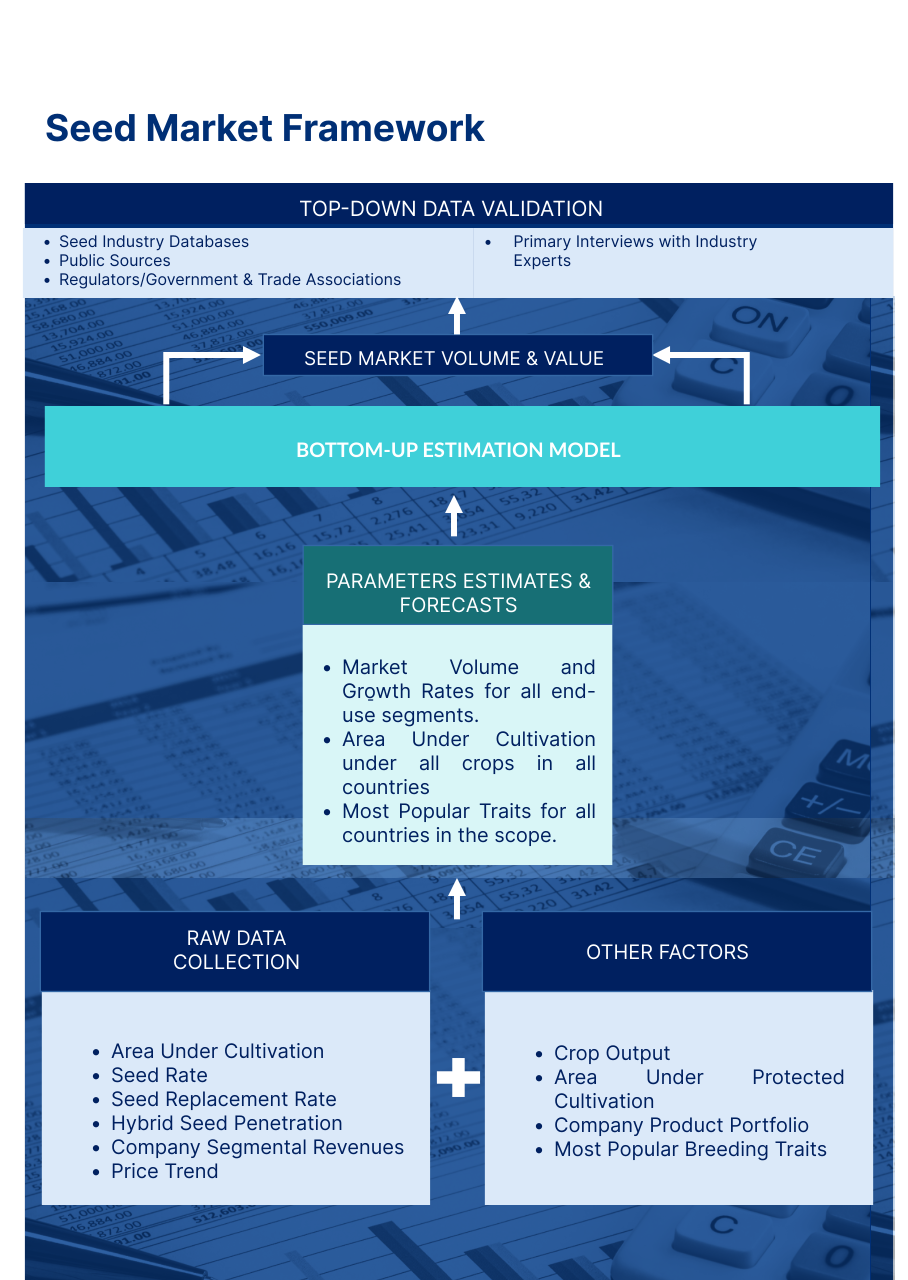
연구 방법론
바카라 사이트는 모든 바카라에서 XNUMX단계 방법론을 따릅니다.
- 1단계: 주요 변수 식별: 강력한 예측 방법론을 구축하기 위해 1단계에서 식별된 변수와 요인을 사용 가능한 과거 바카라사이트 온카판 수치와 비교하여 테스트합니다. 반복적인 과정을 통해 바카라사이트 온카판 예측에 필요한 변수를 설정하고 이를 기반으로 모델을 구축한다.
- 2단계: 바카라사이트 온카판 모델 구축: 예측 연도의 바카라사이트 온카판 규모 추정치는 명목 기준입니다. 인플레이션은 가격 책정의 일부가 아니며 평균 판매 가격(ASP)은 예측 기간 내내 일정하게 유지됩니다.
- 3단계: 확인 및 마무리: 이 중요한 단계에서 모든 바카라사이트 온카판 수치, 변수 및 분석가 호출은 연구 대상 바카라사이트 온카판의 주요 연구 전문가로 구성된 광범위한 네트워크를 통해 검증됩니다. 응답자는 연구 대상 바카라사이트 온카판의 전체론적 그림을 생성하기 위해 수준과 기능에 따라 선택됩니다.
- 4단계: 연구 산출물: 신디케이트된 바카라, 맞춤형 컨설팅 할당, 데이터베이스 및 구독 플랫폼
연구 방법론에 대한 자세한 내용을 확인하세요
PDF 다운로드