
토토 바카라 전기 계량기 시장 규모 및 점유율
토토 바카라 개관
| 학습 기간 | 2019 - 2030 |
|---|---|
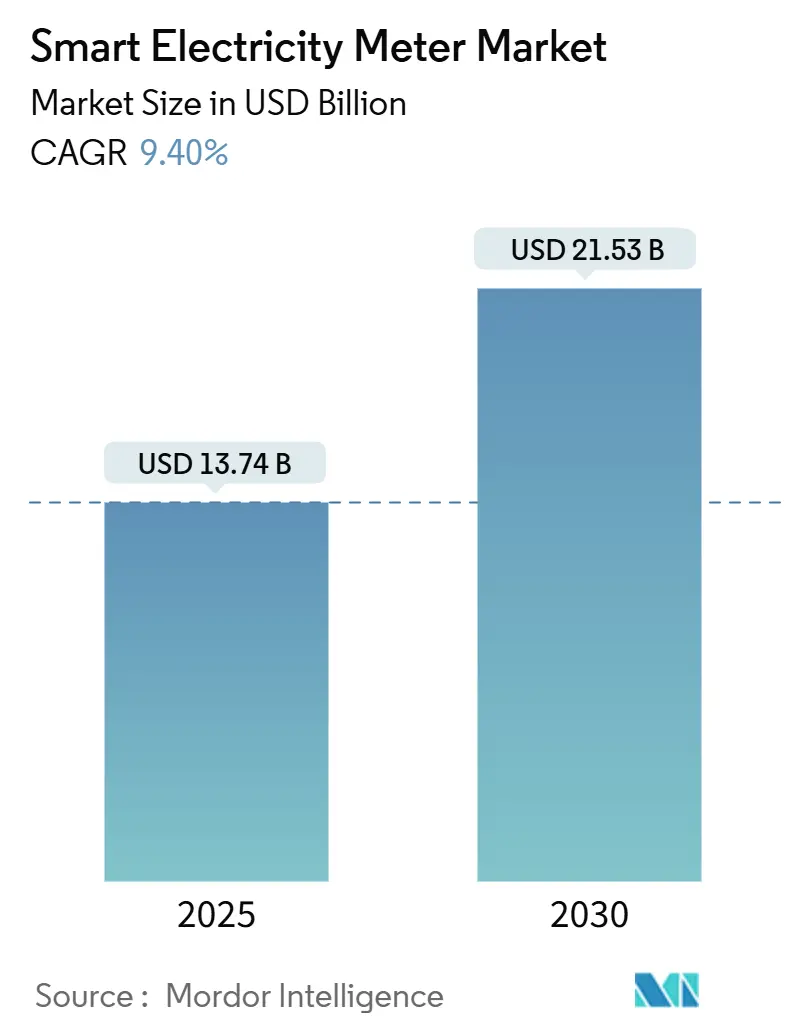
| 토토 바카라 규모(2025년) | USD 13.74 십억 |
| 토토 바카라 규모(2030년) | USD 21.53 십억 |
| 성장률(2025년~2030년) | 9.40 % CAGR |
| 가장 빠르게 성장하는 토토 바카라 | 중동 |
| 가장 큰 시장 | 아시아 태평양 |
| 시장 집중 | 중급 |
주요 선수
*면책조항: 주요 플레이어는 특별한 순서 없이 정렬되었습니다. 이미지 © 바카라 사이트. 재사용 시 CC BY 4.0에 따라 저작자 표시가 필요합니다. |
|
바카라 사이트의 토토 바카라 전기 계량기 시장 분석
The Smart Electricity Meter Market size is estimated at USD 13.74 billion in 2025, and is expected to reach USD 21.53 billion by 2030, at a CAGR of 9.40% during the forecast period (2025-2030). The smart electricity meter market is advancing on the back of grid-modernization mandates, steep renewable-integration targets and a steady drop in connectivity costs. Utilities are reframing meters as grid-edge intelligence nodes that support outage management, power-quality analytics and distributed-energy-resource orchestration. Cellular and NB-IoT connectivity are breaking the cost–performance barrier once held by PLC, encouraging late-adopting utilities to leapfrog first-generation AMR systems. Meanwhile, component miniaturization and embedded AI are enabling high-resolution data capture, which supports flexible pricing programs and virtual power plants. Asia’s economies of scale continue to push average selling prices down, allowing smaller utilities in Latin America, Africa and Southeast Asia to unlock new deployment budgets.
주요 바카라 요약
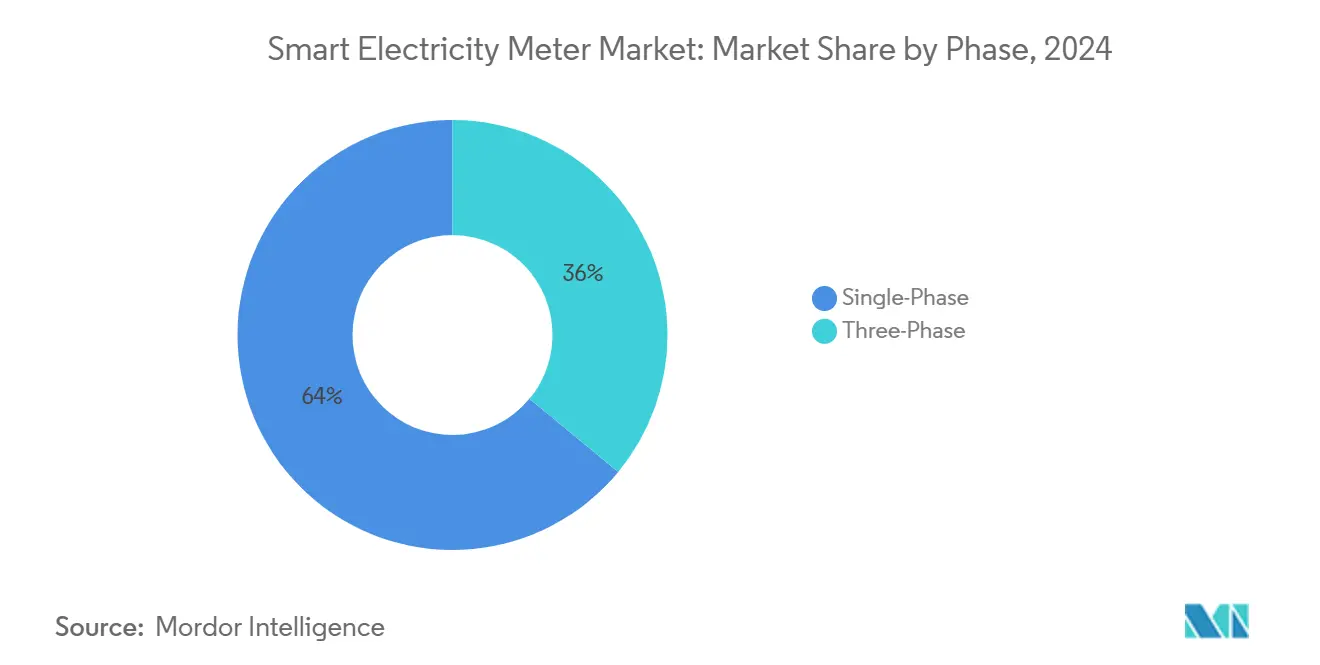
- By phase, single-phase meters led with a 64% revenue share in 2024; three-phase devices are projected to grow at a 10.3% CAGR through 2030.
- By communication technology, PLC held 45% of the smart electricity meter market share in 2024, while cellular/NB-IoT is forecast to post a 12% CAGR between 2025-2030.
- By technology, AMI is expected to dominate the smart electricity meter market with a 68% share of the market size in 2024, and is projected to advance at a 11.5% CAGR through 2030.
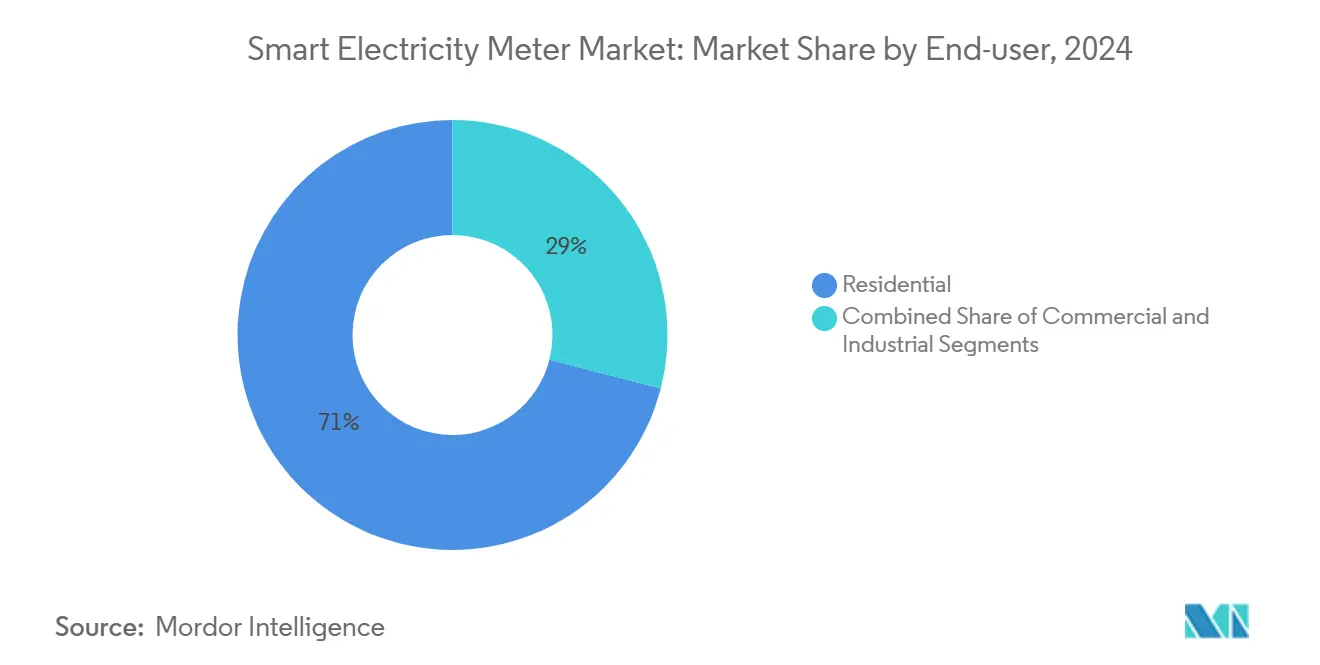
- By end-user, the residential segment accounted for 71% of 2024 revenues, while the industrial segment is expected to register a 10.7% CAGR from 2024 to 2030.
- By installation mode, new deployments accounted for 58% of shipments in 2024; retrofit projects are expected to grow at a 9.8% CAGR through 2030.
- By geography, the Asia Pacific held 48% of the smart electricity meter market share in 2024, while the Middle East is forecast to post a 10.5% CAGR between 2025 and 2030.
글로벌 토토 바카라 전기 계량기 시장 동향 및 통찰력
드라이버 영향 분석
| 운전기사 | (~) CAGR 예측에 미치는 영향 | 지리적 관련성 | 영향 타임라인 |
|---|---|---|---|
| Mandatory EU-2025 three-phase replacement mandates | 2.50% | European Union, UK, Switzerland, Norway | 중기(2~4년) |
| China NB-IoT smart-토토 바카라 mega-tenders | 2.20% | China, spillover in Southeast Asia | 단기 (≤2년) |
| U.S.–Japan demand-response AMI roll-outs | 1.80% | USA, Japan; influence on South Korea & Taiwan | 중기(2~4년) |
| Prosumer billing surge in Oceania | 1.50% | Australia, New Zealand; adoption in Western Europe | 중기(2~4년) |
| Grid-modernization stimulus in Southern Cone | 1.30% | Chile, Argentina, Brazil (spillover) | 중기(2~4년) |
| GCC time-of-use tariff introduction | 1.60% | Saudi Arabia, UAE, Oman; wider GCC | 장기(≥4년) |
| 출처: 모르도르 정보 | |||
Mandatory EU-2025 Three-Phase Replacement Mandates
Europe’s legally binding schedule to swap legacy three-phase 토토 바카라s forces utilities to replace millions of commercial and industrial units before 2027. Utilities are seizing the window to roll out AMI platforms that capture granular interval data and support sub-토토 바카라ing services. 토토 바카라 vendors benefit from a higher average selling price, roughly triple that of single-phase units, while software providers gain recurring revenue through data-management contracts. Capital spending earmarked for compliance is also accelerating investment in data hubs that will underpin tariff innovation and demand-side flexibility programs.
China NB-IoT Smart-토토 바카라 Mega-Tenders
The State Grid Corporation’s 2025 tender for 6 million dual-mode NB-IoT 토토 바카라s cements cellular connectivity as a price-competitive option. Bulk procurement compresses component costs for global buyers and speeds certification cycles for modem vendors. The 토토 바카라s’ dual-band design future-proofs deployments against 2G sunsets, while cloud-native head-end systems streamline software upgrades. These operational gains resonate with Southeast Asian utilities that share similar urban density challenges, reinforcing China’s design template as a de-facto standard.
U.S.–Japan Demand-Response AMI Roll-Outs
North American and Japanese utilities are layering real-time price signals on second-generation AMI, steering large household appliances and EV chargers away from peak load. This shift shifts value toward 토토 바카라s capable of edge computing and rapid firmware updates. Vendors capture premium margins by bundling distributed-intelligence applications that unlock non-commodity revenues for utilities, such as grid-support services. The collaborative pilots now underway in South Korea and Taiwan rely heavily on lessons learned from the U.S.–Japan experience, propagating best practices across the Pacific.[1] Smart Energy International, “Japan Surpasses 100 Million Smart 토토 바카라s,” smart-energy.com
Prosumer Billing Surge in Oceania
High rooftop solar penetration in Australia and New Zealand requires 토토 바카라s that can register inflows and outflows every few seconds. Regulatory bodies are nudging retailers toward cost-reflective tariffs, creating a commercial rationale for feature-rich 토토 바카라s. Successful rollouts are fueling Western Europe’s tariff-design debate, especially in markets with accelerating heat pump uptake. Vendors with strong phase-imbalance measurement capabilities and sub-second logging capabilities are well-positioned to capitalize on this opportunity.[2]Australian Energy Market Commission, “Smart 토토 바카라 Plan 2030,” aemc.gov.au
제약 영향 분석
| 제지 | (~) CAGR 예측에 미치는 영향 | 지리적 관련성 | 영향 타임라인 |
|---|---|---|---|
| ASIC supply-chain shortages inflate BOM costs | -1.50 % | 글로벌; 북미 및 유럽에서 급성 | 단기 (≤2년) |
| UK CPA/EU RED cyber-certification delays | -1.20 % | Europe; ripple effects in aligned markets | 중기(2~4년) |
| RF-emission pushback in France and Canada | -1.00 % | France, Canada; influence on select EU markets | 중기(2~4년) |
| Legacy-SCADA incompatibility in Sub-Saharan utilities | -1.40 % | Sub-Saharan Africa utilities and municipal networks | 장기(≥4년) |
| 출처: 모르도르 정보 | |||
ASIC Supply-Chain Shortages Inflate BOM Costs
Persistent scarcity of specialized processors continues to lift 토토 바카라 manufacturing expenses by 15-25%. Smaller vendors are redesigning boards to use multi-purpose MCUs, extending validation cycles and inflating working capital. Several North American municipal utilities have postponed tranche-two deployments until 2027 in the hope that wafer fabs coming online in 2026 will relieve shortages. The squeeze is most acute for AMI 토토 바카라s that require cryptographic acceleration and edge-analytics cores
UK CPA/EU RED Cyber-Certification Delays
Europe’s evolving cybersecurity rulebook compels vendors to produce country-specific firmware and undergo extended lab testing. Lead times for Commercial Product Assurance (CPA) approval now exceed 14 months, disrupting tender award schedules. Utilities in Ireland and Scandinavia are inserting optional delays into framework contracts to hedge against further policy shifts. The extra compliance overhead is eroding profit margins for mid-tier suppliers and complicating multi-country product roadmaps.
세그먼트 분석
By Phase: Industrial Three-Phase Momentum
Single-phase meters led with a 64% revenue share in 2024, whereas three-phase devices are projected to grow at a 10.3% CAGR through 2030. Utilities favor them for medium-voltage feeders, renewable inverters, and EV fast-chargers that demand harmonic-rich load profiling. In contrast, single-phase units, although still numerically dominant, are shifting toward replacement cycles driven by cybersecurity and firmware upgrade requirements. Field-proven accuracy in non-linear load environments has removed a historic adoption barrier for industrial automation users, boosting order backlogs among meter OEMs in Germany, Italy, and Poland.
The segment benefits from the EU mandate that forces advanced three-phase functions such as voltage sag logging and integrated disconnect relays. As a result, the smart electricity meter market is experiencing a clear shift in value towards higher-margin industrial contracts. Three-phase shipments command average selling prices roughly 2.8 times that of residential units, thereby enlarging the smart electricity meter market size for commercial and industrial applications. Vendors are bundling power-quality modules and carbon-intensity reporting to differentiate, and utilities are responding by launching subscription-based analytics that monetize the new data stream.
통신 기술을 통해: 셀룰러 연결 가속화
Power-Line Communication (PLC) retained a 45% share in 2024, underpinned by deep penetration in Europe’s LV networks. Yet cellular NB-IoT and LTE-M modules are closing the cost gap and are on track for a 12% CAGR through 2030. Successful Chinese mega-tenders showcase deployment timelines that beat PLC by six months in dense urban corridors. The smart electricity meter market is shifting toward hybrid architectures, where RF mesh backhauls the outskirts while cellular technology covers high-rise clusters, ensuring contiguous coverage without the need for repeater farms.
eSIM adoption simplifies provisioning because utilities can switch carriers without truck rolls, cutting opex by up to 35%. Field trials in Brazil confirm that NB-IoT penetration into basements and meter rooms outperforms legacy mesh by 22 percentage points. The cellular uptrend expands the smart electricity meter market share of telecom-centric vendors that bundle managed connectivity with hardware. As roaming costs decline, African utilities are utilizing cross-border cellular agreements to standardize AMI formats, thereby reducing import duties associated with proprietary mesh radios.
By Technology: AMI as Grid-Intelligence Backbone
Advanced Metering Infrastructure accounted for 68% of 2024 revenue and is expected to post an 11.5% CAGR, lifting AMI revenue to a prominent level by 2030. The leap from first-generation AMR to bidirectional AMI 2.0 unlocks feeder-level loss detection, remote reconnect, and tariff switching in under 5 seconds. Edge AI on the meter now flags neutral faults and meter tamper events locally, reducing field visits by 18%. Landis+Gyr and Itron have shipped more than 13 million distributed-intelligence meters, cementing their lead in software-defined infrastructure.
AMR’s footprint is expected to shrink to 19% by 2030 as retrofit kits convert legacy registers into low-cost edge devices, thereby preserving sunk capital while layering AMI functions. The smart electricity meter market size for AMI is expanding fastest where regulators earmark stimulus for grid digitization, notably in Brazil’s Pro-Meter Program. Cloud-native head-end systems that scale elastically during billing cycles further enhance the economics, nudging cooperative utilities with tight budgets to adopt AMI deployments immediately.
By End-User: Industrial Uptake Gains Pace
Residential deployments remained the leading segment, accounting for 71% of 2024 shipments, reflecting nationwide rollouts in China, India, and the EU. Nonetheless, the industrial sub-segment is forecast to grow at a 10.7% CAGR as manufacturers prioritize power-quality visibility and carbon footprint audits. Time-of-use tariffs coupled with real-time consumption dashboards deliver direct production-cost savings, prompting large automotive plants in Mexico and Turkey to pilot 토토 바카라-driven peak-shaving schemes.
Commercial properties such as retail chains and data centers are layering sub-metering on existing AMI to allocate internal costs accurately. This convergence of operational technology and IT services expands the market for smart electricity meters. As ESG reporting rules tighten, smart meters are evolving into energy- and carbon-data loggers, a feature driving an uptick in procurement tenders across Southeast Asian free-trade zones.
참고: 바카라 구매 시 사용 가능한 모든 개별 세그먼트의 세그먼트 공유
By Installation Mode: Retrofits Expand Addressable Base
New installations dominated the early adoption cycles of the smart electricity meter market by 58% in 2024, but retrofit and replacement projects are projected to rise at a 9.8% CAGR. Utilities with first-generation AMR fleets are opting for snap-on communication modules that enable firmware downloads and remote disconnect without swapping the entire meter enclosure. This approach lowers average upgrade cost by up to 60%, freeing budget for analytics software.
Consumer panels indicate that 62% of households prefer a non-invasive retrofit that preserves existing sockets, thereby accelerating acceptance in price-sensitive markets. Field pilots in South Africa have demonstrated that retrofitted meters reduce non-technical losses by 23% within 12 months. As retrofit economics mature, the smart electricity meter market experiences renewed growth pockets, even in territories with near-saturated penetration, extending vendor revenue cycles.
지리 분석
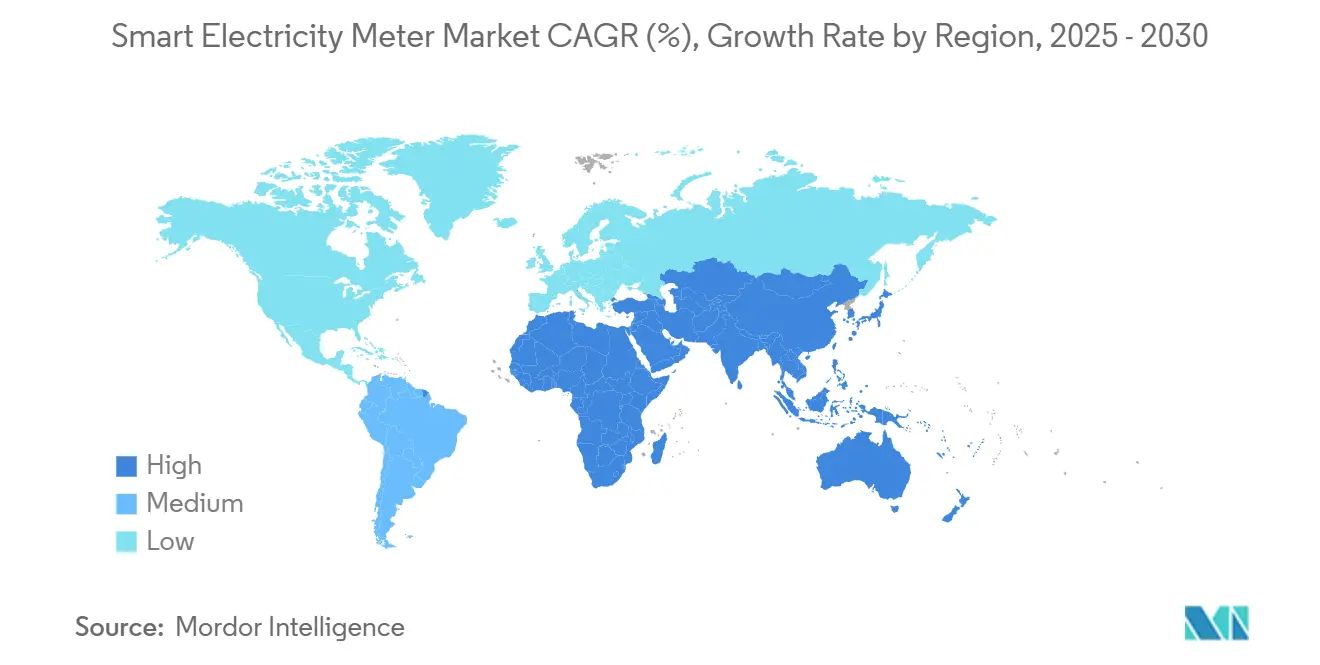
Asia Pacific held a revenue share of 48% in the smart electricity meter market in 2024 and contributed a significant share of global shipments in 2024, continuing to be the volume engine of the smart electricity meter market. China alone has deployed 590 million AMI endpoints across 26 provinces, giving local suppliers unrivaled scale advantages. India’s federal push toward 250 million prepaid smart meters by 2027 is spurring public-private joint ventures and unlocking third-party financing structures. High-density urban nodes in Japan and South Korea are rolling out AMI 2.0 to capture sub-second event data, thereby enhancing their power-quality oversight amid the surge in rooftop solar installations.
From 2025 to 2030, the Middle East's smart electricity 토토 바카라 market is set to grow at a robust rate of 10.5%. This surge is largely driven by utilities in the Gulf Cooperation Council (GCC) pushing for grid digitalization, implementing time-of-use tariffs, and emphasizing demand-side management. In countries such as Saudi Arabia, the UAE, and Oman, extensive rollouts of Advanced 토토 바카라ing Infrastructure (AMI) are enhancing billing precision and visibility during power outages. Additionally, the region's momentum is bolstered by a rising adoption of rooftop solar, updates in regulations, and ambitious efficiency targets.
North America achieved 77% penetration by 2024, with utilities now swapping first-wave AMI units for devices that integrate outage-detection algorithms and EV-load forecasting. The U.S. Department of Energy’s USD 10.5 billion grid-resilience grant scheme helps mid-size municipals justify upgrades that include meter-centric fault-isolation routines. The region’s insistence on open-standards such as Wi-SUN cultivates an ecosystem of interoperable software vendors, thereby increasing competitive tension and driving down lifecycle costs.
Europe’s policy-driven landscape stands out for its strict cybersecurity and data-privacy mandates. With 56% of customers already on smart 토토 바카라s by end-2022, the continent pivots toward harmonizing data access so that retailers can offer flexible tariffs across borders.[3]ESMIG, “Electricity Market Design Reform 2024,” esmig.euA EUR 5 billion innovation fund aims for 90% coverage by 2027 and earmarks AI-enabled load forecasting as a critical deliverable. The mandatory three-phase replacement starting in 2025 is accelerating industrial uptake, especially in Germany, Spain and the Nordic bloc.
경쟁 구도
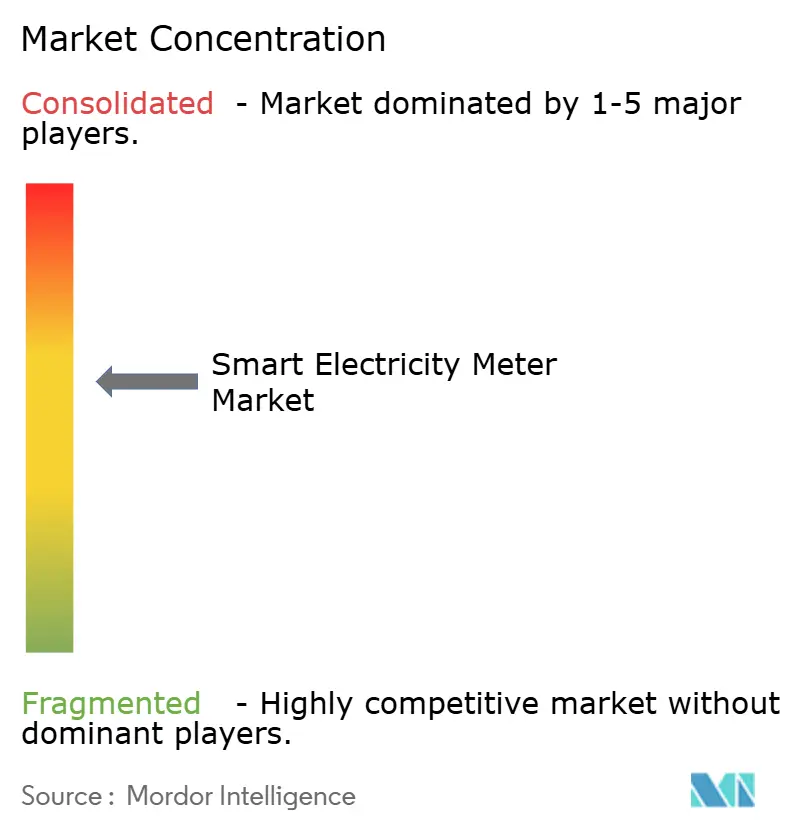
The top five suppliers captured a significant share of shipments in 2024, reflecting moderate concentration. Landis+Gyr leads through aggressive R&D spend on distributed intelligence while Itron leverages a growing managed-services backlog. Sagemcom consolidates European share by pairing hardware with demand-response software, and Honeywell’s Elster line maintains a strong retrofit franchise. Regional specialists such as Wasion Group and Jiangsu Linyang succeed through cost-competitive designs tuned to domestic standards, narrowing price gaps with multinationals.
Strategic acquisitions illustrate a pivot toward recurring software revenues. Macquarie’s 2025 purchase of Iberdrola’s UK meter fleet grants long-term rental income and a platform for value-added services. Conlog’s partnership with Plentify targets Africa’s unique grid constraints by embedding load-control logic into prepaid meters. Tata Consultancy Services collaborates with Landis+Gyr to bundle analytics into utility cloud migrations, strengthening cross-sell potential.
Product roadmaps converge on AI-embedded silicon that performs on-meter anomaly detection, reducing data backhaul and latency. Cyber-hardening features compliant with EU RED and UK CPA are now baseline requirements for tenders. Vendors capable of shipping at scale while meeting divergent cybersecurity regimes hold a clear advantage. The rise of open-source head-end software is lowering entry barriers for integrators, injecting fresh competitive pressure into service contracts.
토토 바카라 전기 계량기 업계 리더
-
Landis+Gyr 그룹 AG
-
아이 트론
-
사젬컴 SAS
-
와시온 그룹 홀딩스
-
Sensus USA Inc.(Xylem Inc.)
- *면책조항: 주요 플레이어는 특별한 순서 없이 정렬되었습니다.
최근 산업 발전
- May 2025: Macquarie acquired Iberdrola’s UK smart-토토 바카라 business for about GBP 900 million, adding 2.7 million endpoints and boosting its portfolio beyond 13 million 토토 바카라s Macquarie Group.
- May 2025: Conlog partnered with Plentify to deliver utility-grade home-energy management across African markets, integrating control algorithms into prepaid 토토 바카라s ESI Africa.
- December 2024: Tata Consultancy Services and Landis+Gyr began a three-year program to mesh TCS Clever Energy with Landis+Gyr’s AMI portfolio Tata Consultancy Services.
- December 2024: Intellihub and Smart launched a Home Energy Kit bundling solar, storage and optimization services for Australian households Intellihub.
글로벌 토토 바카라 전기 계량기 시장 바카라 범위
The Smart Electricity 토토 바카라 Market Report is Segmented by Phase (Single-Phase, and Three-Phase), Communication Technology (Power-Line Communication (PLC), Radio-Frequency Mesh, Cellular (NB-IoT / LTE-M), and Hybrid / Others), Technology (Advanced 토토 바카라ing Infrastructure (AMI), and Automatic 토토 바카라 Reading (AMR)), End-user (Residential, Commercial, and Industrial), Installation Mode (New Installations, and Retrofits / Replacements), and Geography. The Market Forecasts are Provided in Terms of Value (USD).
| 단상 |
| 세 단계 |
| 전력선 통신(PLC) |
| Radio-Frequency Mesh |
| 셀룰러(NB-IoT/LTE-M) |
| 하이브리드/기타 |
| 고급 측정 인프라(AMI) |
| AMR(자동 검침) |
| 주거 |
| 상업용 |
| 산업(공업) |
| 새로운 설치 |
| 개조/교체 |
| 북아메리카 | United States |
| Canada | |
| 멕시코 | |
| 남아메리카 | 브라질 |
| Chile | |
| 콜롬비아 | |
| 남아메리카의 나머지 지역 | |
| 유럽 | 영국 |
| 독일 | |
| 프랑스 | |
| 스페인 | |
| 이탈리아 | |
| 북유럽 | |
| 베네룩스 | |
| 유럽의 나머지 | |
| 아시아 태평양 | 중국 |
| India | |
| 일본 | |
| 대한민국 | |
| 동남 아시아 | |
| 아시아 태평양 지역의 나머지 | |
| 중동 | GCC |
| 튀르키예 | |
| Israel | |
| 중동의 나머지 지역 | |
| 아프리카 | South Africa |
| Egypt | |
| 아프리카의 나머지 지역 |
| 단계별 | 단상 | |
| 세 단계 | ||
| 통신 기술별 | 전력선 통신(PLC) | |
| Radio-Frequency Mesh | ||
| 셀룰러(NB-IoT/LTE-M) | ||
| 하이브리드/기타 | ||
| 기술 별 | 고급 측정 인프라(AMI) | |
| AMR(자동 검침) | ||
| 최종 사용자 | 주거 | |
| 상업용 | ||
| 산업(공업) | ||
| 설치 모드별 | 새로운 설치 | |
| 개조/교체 | ||
| 지리학 | 북아메리카 | United States |
| Canada | ||
| 멕시코 | ||
| 남아메리카 | 브라질 | |
| Chile | ||
| 콜롬비아 | ||
| 남아메리카의 나머지 지역 | ||
| 유럽 | 영국 | |
| 독일 | ||
| 프랑스 | ||
| 스페인 | ||
| 이탈리아 | ||
| 북유럽 | ||
| 베네룩스 | ||
| 유럽의 나머지 | ||
| 아시아 태평양 | 중국 | |
| India | ||
| 일본 | ||
| 대한민국 | ||
| 동남 아시아 | ||
| 아시아 태평양 지역의 나머지 | ||
| 중동 | GCC | |
| 튀르키예 | ||
| Israel | ||
| 중동의 나머지 지역 | ||
| 아프리카 | South Africa | |
| Egypt | ||
| 아프리카의 나머지 지역 | ||
바카라에서 답변 한 주요 질문
What is the current size of the smart electricity 토토 바카라 market?
The smart electricity 토토 바카라 market size stands at USD 13.74 billion in 2025 and is projected to reach USD 21.53 billion by 2030.
Which phase segment is expanding fastest?
Three-phase 토토 바카라s are forecast to grow at a 10.3% CAGR from 2025-2030, outpacing single-phase units driven by Europe’s replacement mandate.
Why are utilities shifting toward cellular NB-IoT connectivity?
Declining module costs, wide coverage and simpler deployment make NB-IoT and LTE-M attractive, enabling 12% CAGR growth in the cellular segment.
How do ASIC shortages affect smart-토토 바카라 rollouts?
Scarcity of specialized chips has lifted 토토 바카라 bills of materials by up to 25% and delayed several North American and European deployments.
Which region records the highest penetration rate?
Asia Pacific leads with 48% penetration in 2024, propelled by strong regulatory support and second-generation AMI upgrades.
Who are the leading companies in the industry?
Landis+Gyr, Itron, Sagemcom, Honeywell (Elster), Wasion Group and Jiangsu Linyang are the principal players, together holding a significant share of global shipments.
페이지 마지막 업데이트 날짜: