
시장 개관
| 학습 기간 | 2017 - 2030 |
| 산정기준연도 | 2024 |
| 예측 데이터 기간 | 2025 - 2030 |
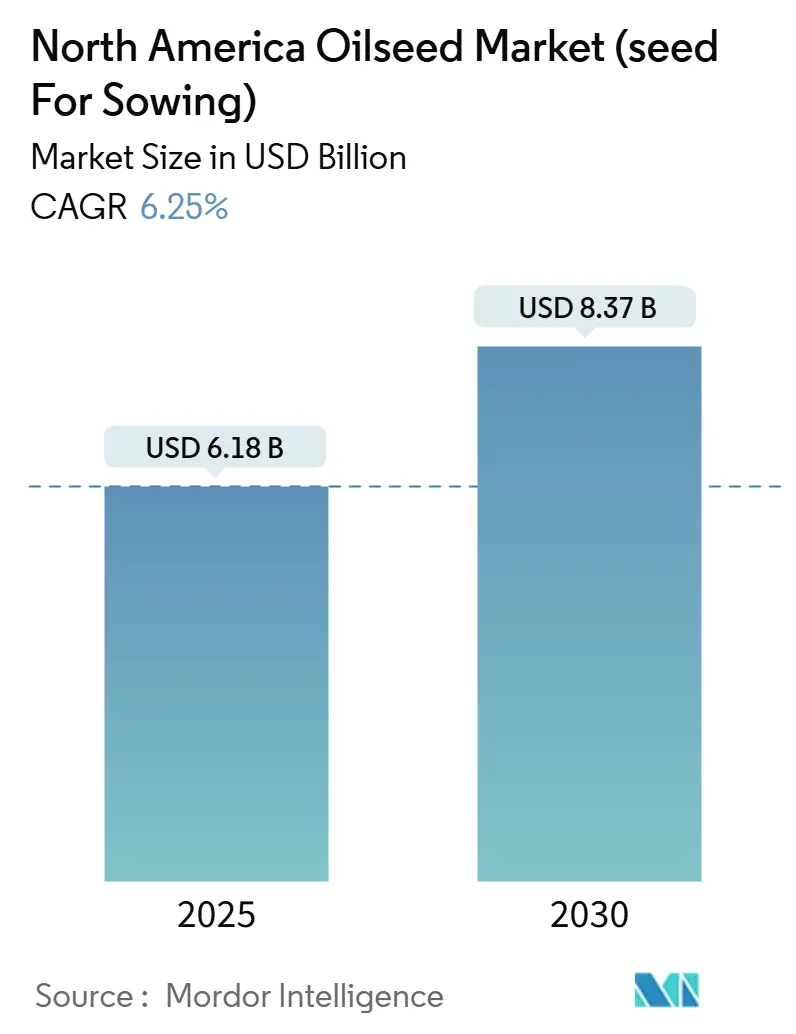
| 시장 규모(2025년) | USD 6.18 십억 |
| 시장 규모(2030년) | USD 8.37 십억 |
| 성장률(2025년~2030년) | 6.25 % CAGR |
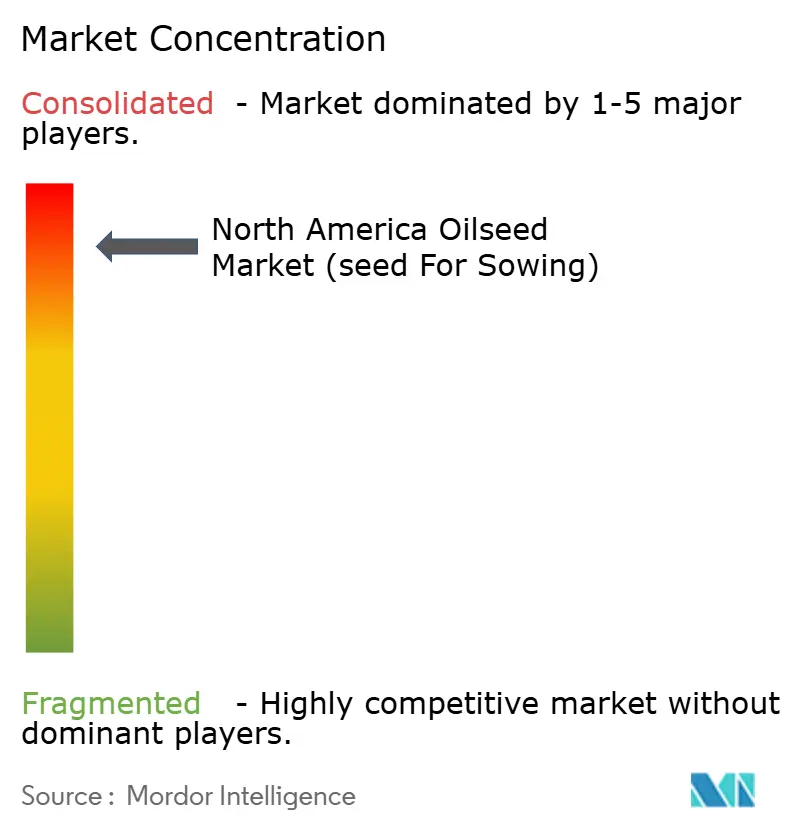
| 시장 집중 | 높음 |
주요 선수
*면책조항: 주요 플레이어는 특별한 순서 없이 정렬되었습니다. 이미지 © 바카라 사이트. 재사용 시 CC BY 4.0에 따라 저작자 표시가 필요합니다. |
|
North America Oilseed Market Analysis by 바카라 사이트
The North America oilseed market (seed for sowing) size is valued at USD 6.18 billion in 2025 and is projected to reach USD 8.37 billion by 2030, advancing at a 6.25% CAGR. Rising renewable diesel mandates, record Canadian canola crushing, and almost universal adoption of herbicide-tolerant genetics are expanding demand while elevating premium seed pricing. Processors are adding capacity to capture the vegetable-oil pull from low-carbon fuel standards, and growers are prioritizing hybrids that integrate multi-trait herbicide packages to protect yields in resistance-prone fields. Weather volatility across the Corn Belt and Prairie provinces continues to disrupt planting calendars, yet seed companies are accelerating gene-edited introductions to counter climate stress. Regulatory scrutiny of herbicide chemistries is shortening product life cycles, intensifying the race for next-generation weed-management traits. Moderate market concentration persists because regional breeders retain share through localized germplasm and carbon-credit-aligned cover-crop offerings that complement multinational portfolios.
주요 바카라 요약
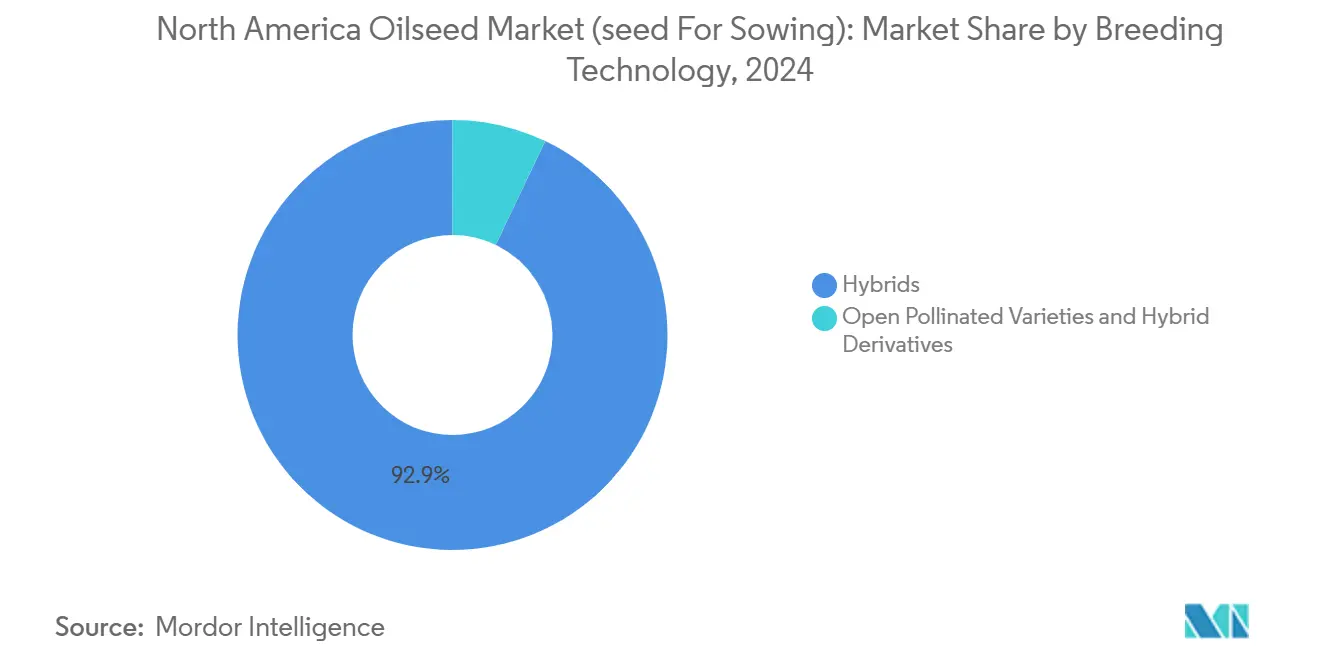
- By breeding technology, hybrids led with 92.9% revenue share in 2024; hybrids are forecast to expand at a 6.30% CAGR through 2030.
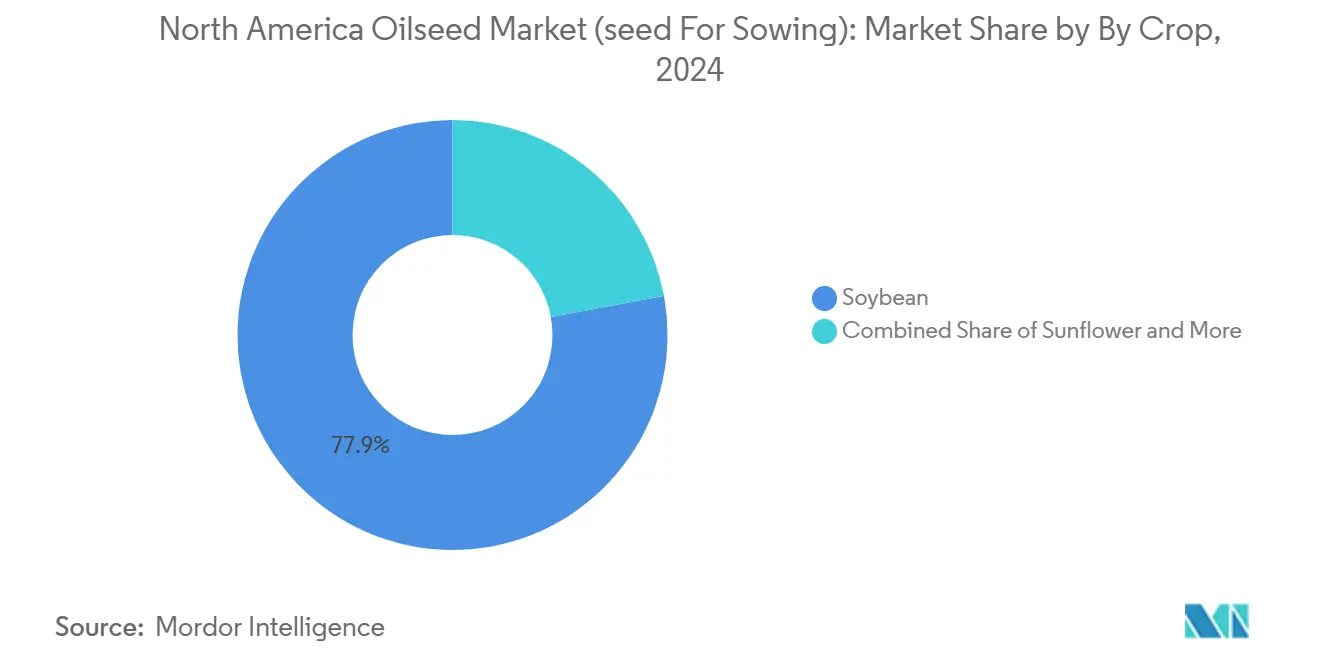
- By crop type, soybean accounted for a 77.9% share of the North America oilseed market (seed for sowing) size in 2024 and are advancing at a 6.77% CAGR through 2030.
- By geography, the United States held 74.9% of the North America oilseed market (seed for sowing) share in 2024, while the country segment is projected to grow at a 6.72% CAGR to 2030.
North America Oilseed Market Trends and Insights
드라이버 영향 분석
| 운전기사 | (~) CAGR 예측에 미치는 영향 | 지리적 관련성 | 영향 타임라인 |
|---|---|---|---|
| Renewable diesel-driven demand surge for vegetable oils | 1.8% | 미국과 캐나다, 멕시코로 확산 | 중기(2~4년) |
| Rapid on-farm adoption of herbicide-tolerant GM traits | 1.2% | The United States and Canada primarily | 단기 (≤ 2년) |
| Record Canadian canola acreage expansion | 0.9% | Canada, with export implications for North America | 중기(2~4년) |
| Dicamba exit accelerates 2,4-D-based trait replacement cycle | 0.7% | United States Midwest and Plains states | 단기 (≤ 2년) |
| Carbon-credit programs stimulate sunflower and flax cover-crop seed demand | 0.5% | The United States and Canada, concentrated in the Prairie provinces | 장기 (≥ 4년) |
| High-oleic soybean contract premiums reshape seed mix | 0.4% | United States Midwest, expanding to Canada | 중기(2~4년) |
출처: 모르도르 정보
Renewable-Diesel Driven Demand Surge for Vegetable Oils
United States renewable diesel capacity is on track to hit 5.9 billion gallons in 2025, more than doubling 2023 output and requiring heavy volumes of soybean and canola oil feedstocks[1]Source: U.S. Energy Information Administration, “U.S. renewable diesel production capacity continues to grow,” eia.gov. Each gallon of fuel consumes roughly 7.6 pounds of vegetable oil, so processors such as Cargill and ADM are racing to expand crush facilities designed for fuel-grade oils. The premium offered by fuel blenders over food markets is widening basis levels for high-oil varieties, steering planting decisions toward genetics that maximize oil yield per acre. Federal and state low-carbon mandates provide a multi-year demand signal that underpins processor investments and encourages growers to pivot acreage from feed grains into oilseeds.
Rapid On-Farm Adoption of Herbicide-Tolerant GM Traits
Herbicide-tolerant soybeans now cover 96% of United States acres, but grower focus has shifted from single glyphosate tolerance to triple-stacked platforms that layer glyphosate, glufosinate, and either dicamba or 2,4-D resistance. This rotation is a direct response to herbicide-resistant weeds that blanket more than 70 million acres in the United States. Trait cycling forces annual seed replacement, lifting royalty collections but also exposing farmers to steeper input costs as trait fees can represent 40% of seed invoices. Health Canada approvals keep pace, clearing transgenic soybeans and canola within months of United States authorizations and allowing simultaneous North American launches. As resistance intensifies, stacked traits become a management necessity rather than a premium option, sustaining growth in the North America oilseed market.
Record Canadian Canola Acreage Expansion
Canadian growers harvested record canola volumes in 2024 as Prairie acreage climbed and crushers operated at 11.4 million metric tons, with exports forecast at 12.5 million metric tons[2]Source: Statistics Canada, “Crushing statistics,” statcan.gc.ca. Canola oil secures a USD 0.05-0.10 per-pound premium over soybean oil because of its favorable cold-flow properties for renewable diesel blends. Virtually all Canadian hectares are planted to hybrid cultivars that deliver 15-20% yield lifts and higher oil profiles. Bayer reinforced its integrated value chain by purchasing a Lethbridge processing site for CAD 127 million (USD 94 million) in November 2024. Land availability is finite, so genetic gain through stress-tolerant hybrids remains the prime lever for output growth, supported by a streamlined Canadian variety-registration process that approved more than 20 new canola lines in 2024.
Dicamba Exit Accelerates 2,4-D-Based Trait Replacement Cycle
EPA restrictions on post-emergence dicamba after the 2024 season have pushed Midwest and Plains growers toward 2,4-D systems to protect soybean yields. Corteva’s Enlist platform is projected to extend soybean acres by 40% in 2025 as farmers seek flexible over-the-top options. The forced trait migration fuels near-term seed demand but also escalates licensing costs because growers must adopt entirely new germplasm to access the chemistry. Early field data already confirm 2,4-D-resistant weed biotypes in 12 states, indicating that the resistance treadmill is shortening and that multi-mode stacks will become standard packages. Seed companies are collaborating on next-generation constructs that combine multiple herbicide sites of action with disease and oil-content traits to sustain efficacy.
제약 영향 분석
| 제지 | (~) CAGR 예측에 미치는 영향 | 지리적 관련성 | 영향 타임라인 |
|---|---|---|---|
| Regulatory uncertainty on GM traits and herbicide bans | -0.8 % | United States and Canada, with Mexico restrictions | 장기 (≥ 4년) |
| Yield volatility from extreme weather events | -0.6 % | North America-wide, concentrated in the Plains states | 단기 (≤ 2년) |
| Herbicide-resistant weed proliferation eroding trait value | -0.5 % | United States Midwest and Plains, expanding to Canada | 중기(2~4년) |
| Rising seed prices from IP concentration hitting small growers | -0.4 % | United States and Canada, affecting mid-scale operations | 중기(2~4년) |
출처: 모르도르 정보
Regulatory Uncertainty on GM Traits and Herbicide Bans
Average regulatory review for new GM traits now exceeds five years in North America, inflating R&D budgets that ultimately filter into seed invoices. The EPA’s drifting stance on chemistries such as glyphosate and glufosinate raises doubts over trait longevity, complicating product-cycle planning for breeders[3]Source: U.S. Environmental Protection Agency, “EPA Announces Final Decision on Dicamba,” epa.gov. Mexico’s proposed GM corn ban underscores global policy risk and signals possible spillover into oilseed approvals. Although the Canadian Food Inspection Agency remains supportive, synchronized launches with the United States mean any delay stalls Canadian market access. Litigation from environmental groups layers added unpredictability, nudging companies to prioritize traits with clearer regulatory paths over cutting-edge gene-edited solutions that lack precedent.
Yield Volatility from Extreme Weather Events
The 2024 season combined delayed Midwest planting from excessive rain with Prairie drought that trimmed Saskatchewan canola yields by 15%. Weather shocks undermine the economics of premium hybrid seeds when yields fail to offset higher costs. Insurance offsets only partial losses, and policy premiums rise as climate volatility intensifies. Specialty crops like flax and sunflower endure tighter planting windows, magnifying exposure to spring moisture swings. Breeders are investing in abiotic-stress traits, yet payback remains uncertain without long-run weather predictability.
세그먼트 분석
By Breeding Technology: Hybrids Drive Innovation Pipeline
Hybrid cultivars held 92.9% of the North America oilseed market (seed for sowing) share in 2024, and this sub-segment is set to advance at a 6.30% CAGR through 2030. Non-transgenic hybrids carve a premium niche among growers serving identity-preserved export channels that restrict GM content, yet their footprint remains small compared with transgenic stacks. Trait developers are pairing hybrid vigor with CRISPR-enabled oil-quality edits that fetch food and fuel premiums, reinforcing the North America oilseed market growth trajectory.
Open-pollinated varieties continue to shrink, sustained mainly by organic rotations where GM traits are prohibited. Hybrid derivatives built on public germplasm offer a transitional step for regional breeders lacking proprietary parents, but royalty terms often mirror full hybrids, limiting uptake. Commercial pipeline data show more than 150 fresh oilseed varieties, almost all hybrid, cleared North American registration in 2024. The intellectual property framework ensures breeders can recoup R&D investment, sustaining innovation momentum.
참고: 바카라 구매 시 사용 가능한 모든 개별 세그먼트의 세그먼트 공유
By Crop: Soybean Dominate Renewable Fuel Transition
Soybean represented 77.9% of the North America oilseed market (seed for sowing) size in 2024 and are forecast to climb at a 6.77% CAGR to 2030. Renewable diesel demand is redirecting soybean oil away from food channels, lifting crush margins and encouraging growers to favor high-oil genetics. Premiums for high-oleic beans spur acreage migration, and stacked herbicide traits ease weed-control logistics during planting delays. Canola ranks second and benefits from record Canadian output, while rapeseed and mustard leverage shared genetics for disease resilience and cold-flow suitability in fuel blends.
Sunflower acreage is rebounding on the strength of carbon-credit programs and drought tolerance that hedges rainfall risk in marginal soils. Flax, safflower, and camelina remain niche contributors but attract R&D dollars for specialized fatty-acid profiles targeting industrial lubricants and aquaculture feed. Gene-editing tools shorten development cycles, positioning these minor crops for demand surges as new bio-based product markets mature.
참고: 바카라 구매 시 사용 가능한 모든 개별 세그먼트의 세그먼트 공유
지리 분석
The United States captured 74.9% of the North America oilseed market (seed for sowing) in 2024 and is projected to grow at a 6.72% CAGR, anchored by an unmatched renewable diesel build-out and a robust extension network that speeds trait diffusion. Crop insurance and commodity-loan programs buffer price risk, supporting higher-cost hybrid adoption even in volatile seasons. Canada follows, propelled by record canola crush and export channels that supply premium vegetable oil to global fuel refiners. Mexican production remains small, constrained by limited irrigated acreage and regulatory caution on GM traits, yet safflower and sunflower fill distinct regional niches.
Canada’s share derives from canola leadership, with 11.4 million metric tons crush in 2024 reflecting vertical integration from hybrid seed to processing. Export orientation positions Canadian growers to capture premiums in European and Asian vegetable-oil markets that value low-temperature flowability. Investments such as Bayer’s Lethbridge plant acquisition consolidate processing close to production to lower freight spreads and retain local value. CFIA’s streamlined approvals accelerate the roll-out of hybrids with higher oil or clubroot resistance that further support yield targets.
Mexico and the rest of North America remain minor contributors due to smaller land tracts and competing high-value crops. Nonetheless, sunflowers and safflowers play strategic roles in arid zones, and emerging water-saving agronomy could edge up acreage. Infrastructure gaps hamper large-scale crush development, but cross-border trade links allow domestic deficits to be covered by the United States and Canadian supply.
경쟁 구도
Market concentration is high: Bayer AG, Corteva Inc., Land O’Lakes Inc., BASF SE, and Syngenta Group leverage combined germplasm and trait platforms to retain scale advantages, yet regional breeders thrive by tailoring hybrids to specific soil and weather profiles. The exit from dicamba and pivot toward 2,4-D creates white space for trait innovators with differentiated herbicide modes, heightening competition. KWS and Limagrain divesting AgReliant Genetics to GDM for USD 2.1 billion in June 2025 highlights portfolio realignment among multinationals to sharpen focus on core crops and geographies.
Intellectual property strength underpins pricing power. Patent filings on stress tolerance and oil-profile edits jumped in 2024, signaling intensified R&D investment cycles. Independent firms capture niche segments by licensing traits on flexible acreage fees, but rising royalty costs limit competitiveness. Carbon-credit demand elevates sunflower and flax genetics, enabling local breeders to carve a share where multinationals lack dedicated programs. Gene-editing start-ups target camelina omega-3 and canola high-protein meal, yet regulatory clarity will dictate commercialization pace.
Multinationals invest heavily in data-driven breeding and precision phenotyping to shorten product cycles and outpace resistance development. Corteva’s USD 100 million facility upgrade in Iowa accelerates gene-edited trait screening, while Bayer integrates processing to capture downstream margins. Competitive intensity will continue to scale as renewable diesel, carbon markets, and regulatory shifts co-evolve and reshape seed profitability.
North America Oilseed Industry Leaders
-
바스프 SE
-
바이엘 AG
-
Land O'Lakes Inc.
-
신젠타 그룹
-
코르테바
- *면책조항: 주요 플레이어는 특별한 순서 없이 정렬되었습니다.
시장 참가자 및 경쟁사에 대한 자세한 정보가 필요하십니까?
PDF 다운로드
최근 산업 발전
- September 2025: KWS SAAT SE and Groupe Limagrain completed the divestiture of AgReliant Genetics to GDM for USD 2.1 billion. The transaction enables KWS and Limagrain to focus resources on their core European and international markets while providing GDM with enhanced North American market presence and access to established corn and soybean breeding programs.
- March 2025: Beck's Superior Hybrids acquired select assets from Gro Alliance, expanding its seed production and distribution capabilities across key Midwest markets. The acquisition includes processing facilities, germplasm assets, and dealer networks that strengthen Beck's position in premium oilseed markets.
- October 2024: Bayer AG acquired a canola processing facility in Lethbridge, Alberta for CAD 127 million (USD 94 million), expanding its integrated canola value chain capabilities. The facility enhances Bayer's ability to capture value from its InVigor canola genetics while supporting growing renewable diesel feedstock demand.
이 바카라를 사용하면 무료
우리는 업계의 기본 구조를 나타내는 지역 및 국가 수준 지표에 대한 포괄적이고 포괄적인 데이터 포인트 세트를 무료로 제공합니다. 90개 이상의 무료 차트 형식으로 제공되는 이 섹션은 범위 내 다양한 작물의 재배 면적에 관해 다양한 지역의 찾기 어려운 데이터를 다룹니다.
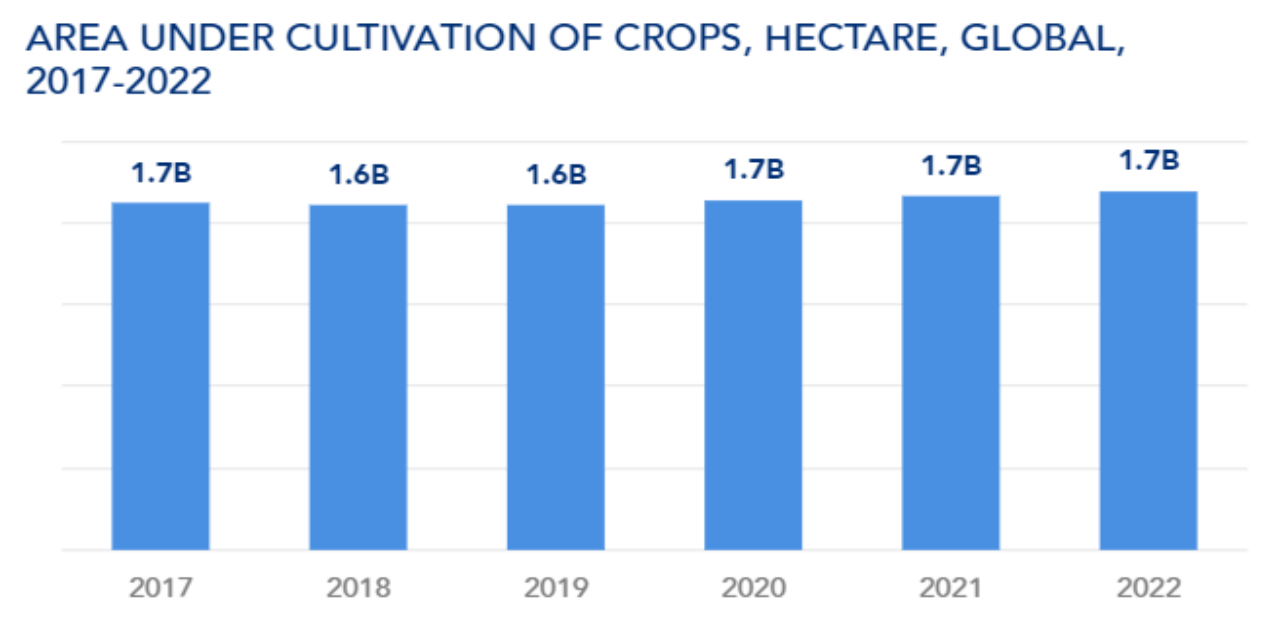
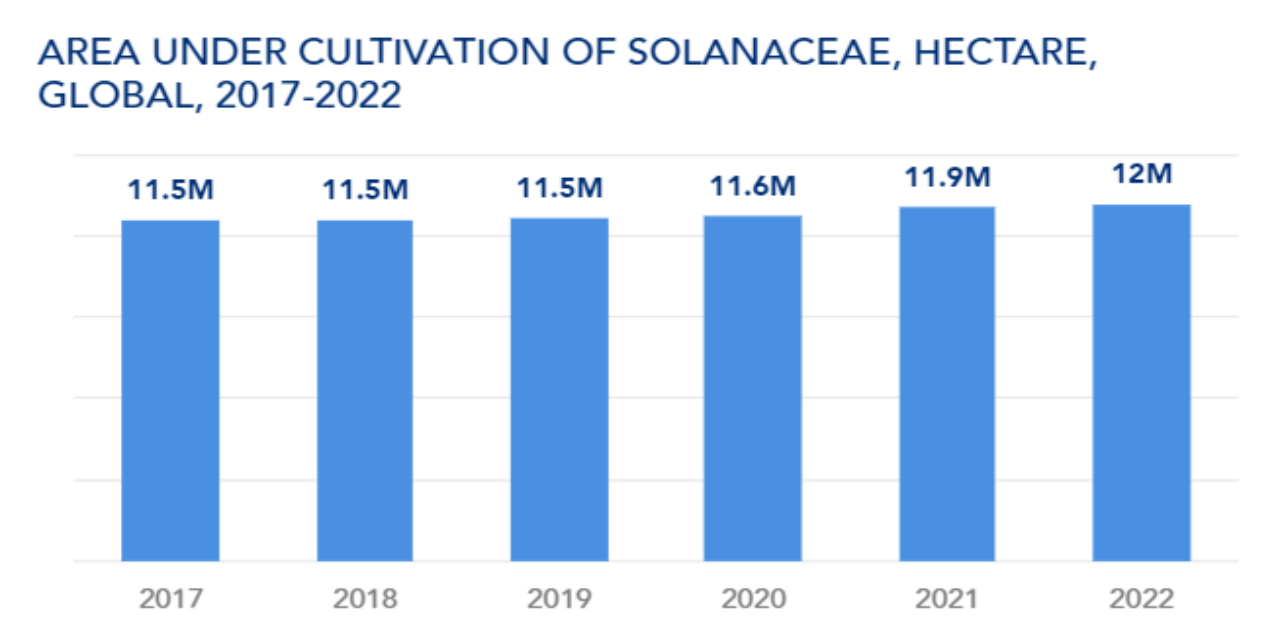
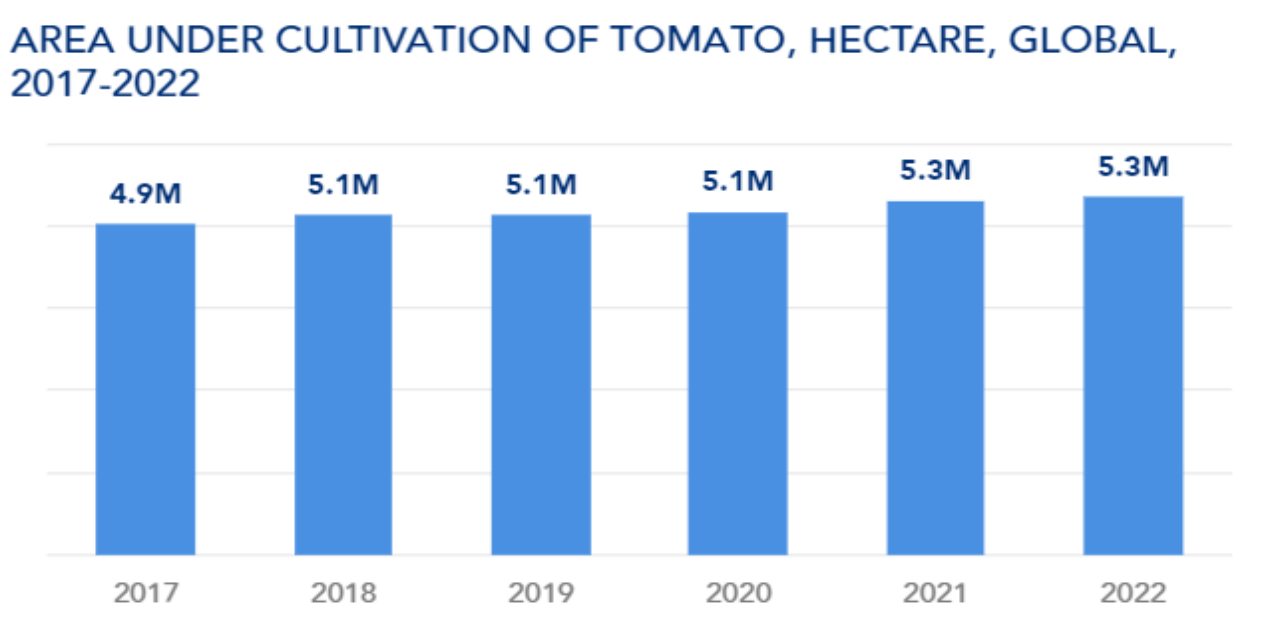
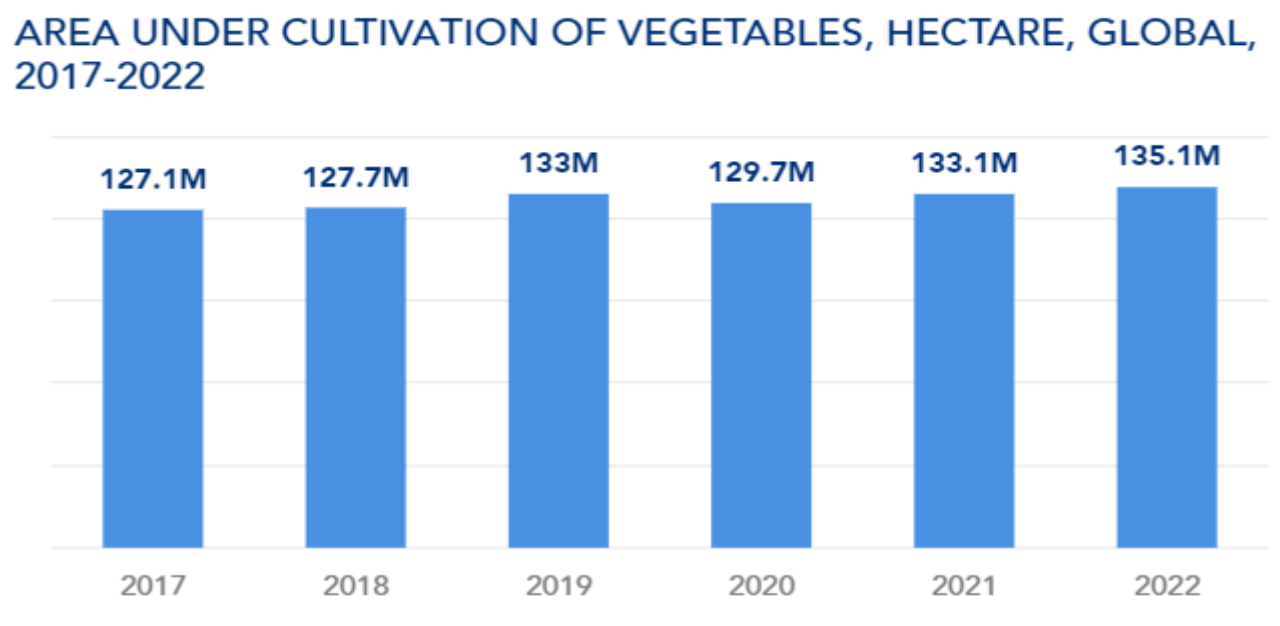
표 및 그림 목록
- 그림 1 :
- 행 작물 재배 면적, 헥타르, 북미, 2017-2022
- 그림 2 :
- 주요 대두 특성의 가치 점유율, %, 북미, 2022
- 그림 3 :
- 행 작물 육종 기술의 가치 점유율, %, 북미, 2022
- 그림 4 :
- 유지 바카라사이트 벳위즈의 양, 미터톤, 북미, 2017년 - 2030년
- 그림 5 :
- 유지 바카라사이트 벳위즈 바카라사이트 벳위즈의 가치, 미국 달러, 북미, 2017년 - 2030년
- 그림 6 :
- 번식 기술 범주별 유지바카라사이트 벳위즈 생산량, 미터톤, 북미, 2017년 - 2030년
- 그림 7 :
- 번식 기술 범주별 유지 바카라사이트 벳위즈의 가치, 미국 달러, 북미, 2017년 - 2030년
- 그림 8 :
- 번식 기술 범주별 유지 바카라사이트 벳위즈의 양 점유율, %, 북미, 2017 VS 2023 VS 2030
- 그림 9 :
- 번식 기술 범주별 유지 바카라사이트 벳위즈의 가치 점유율, %, 북미, 2017 VS 2023 VS 2030
- 그림 10 :
- 2017년 - 2030년, 잡종 카테고리별 유지바카라사이트 벳위즈 바카라사이트 벳위즈량, 미터톤, 북미
- 그림 11 :
- 하이브리드 카테고리별 유지바카라사이트 벳위즈 바카라사이트 벳위즈의 가치, 미국, 북미, 2017년 - 2030년
- 그림 12 :
- 잡종 카테고리별 유지바카라사이트 벳위즈 생산량 점유율, %, 북미, 2017 VS 2023 VS 2030
- 그림 13 :
- 하이브리드 카테고리별 유지바카라사이트 벳위즈 가치 점유율, %, 북미, 2017 VS 2023 VS 2030
- 그림 14 :
- 비형질전환 잡종 유지바카라사이트 벳위즈 바카라사이트 벳위즈의 양, 미터톤, 북미, 2017년 - 2030년
- 그림 15 :
- 비형질전환 잡종 유지바카라사이트 벳위즈 바카라사이트 벳위즈의 가치, 미국 달러, 2017년 - 2030년
- 그림 16 :
- 작물별 비형질전환 잡종 유지바카라사이트 벳위즈 바카라사이트 벳위즈의 가치 점유율, %, 북미, 2023년 및 2030년
- 그림 17 :
- 형질전환 잡종 카테고리별 유지바카라사이트 벳위즈 바카라사이트 벳위즈의 양, 미터톤, 북미, 2017년 - 2030년
- 그림 18 :
- 형질전환 잡종 카테고리별 유지 바카라사이트 벳위즈 바카라사이트 벳위즈의 가치, 미국 달러, 북미, 2017년 - 2030년
- 그림 19 :
- 형질전환 잡종 카테고리별 유지 바카라사이트 벳위즈의 부피 점유율, %, 북미, 2017 VS 2023 VS 2030
- 그림 20 :
- 형질전환 잡종 카테고리별 유지바카라사이트 벳위즈 가치 점유율, %, 북미, 2017 VS 2023 VS 2030
- 그림 21 :
- 제초제 내성 잡종 유지바카라사이트 벳위즈 바카라사이트 벳위즈의 양, 미터톤, 북미, 2017년 - 2030년
- 그림 22 :
- 제초제 내성 잡종 유지바카라사이트 벳위즈 바카라사이트 벳위즈의 가치, 미국 달러, 북미, 2017년 - 2030년
- 그림 23 :
- 작물별 제초제 내성 잡종 유지바카라사이트 벳위즈 바카라사이트 벳위즈의 가치 점유율, %, 북미, 2023년 및 2030년
- 그림 24 :
- 곤충 저항성 잡종 유지바카라사이트 벳위즈 바카라사이트 벳위즈의 양, 미터톤, 북미, 2017년 - 2030년
- 그림 25 :
- 곤충 저항성 잡종 유지 바카라사이트 벳위즈 바카라사이트 벳위즈의 가치, 미국 달러, 2017년 - 2030년
- 그림 26 :
- 작물별 곤충 저항성 잡종 유지바카라사이트 벳위즈 바카라사이트 벳위즈의 가치 점유율(%), 북미, 2023년 및 2030년
- 그림 27 :
- 기타 특성 유지바카라사이트 벳위즈 바카라사이트 벳위즈의 양, 미터톤, 북미, 2017년 - 2030년
- 그림 28 :
- 기타 특성 유지 바카라사이트 벳위즈 바카라사이트 벳위즈의 가치, USD, 북미, 2017 - 2030
- 그림 29 :
- 작물별 기타 특성 유지바카라사이트 벳위즈 바카라사이트 벳위즈의 가치 점유율, %, 북미, 2023년 및 2030년
- 그림 30 :
- 개방 수분 품종 및 하이브리드 파생품 유지 바카라사이트 벳위즈 바카라사이트 벳위즈의 양, 미터톤, 북미, 2017년 - 2030년
- 그림 31 :
- 개방 수분 품종 및 하이브리드 파생품 유지 바카라사이트 벳위즈 바카라사이트 벳위즈의 가치, 미국 달러, 북미, 2017 - 2030
- 그림 32 :
- 작물별 개방 수분 품종 및 잡종 파생물 유지 바카라사이트 벳위즈 바카라사이트 벳위즈의 가치 점유율, %, 북미, 2023년 및 2030년
- 그림 33 :
- 작물 카테고리별 유지바카라사이트 벳위즈 생산량, 미터톤, 북미, 2017년 - 2030년
- 그림 34 :
- 작물 카테고리별 유지바카라사이트 벳위즈 바카라사이트 벳위즈 가치, 미국 달러, 북미, 2017년 - 2030년
- 그림 35 :
- 작물 카테고리별 유지바카라사이트 벳위즈 생산량 점유율, %, 북미, 2017 VS 2023 VS 2030
- 그림 36 :
- 작물 카테고리별 유지바카라사이트 벳위즈 가치 점유율, %, 북미, 2017 VS 2023 VS 2030
- 그림 37 :
- 캐놀라, 유채, 겨자씨의 양, 미터톤, 북미, 2017년 - 2030년
- 그림 38 :
- 캐놀라, 유채, 겨자씨의 가치, 미국 달러, 북미, 2017년 - 2030년
- 그림 39 :
- 사육 기술에 따른 카놀라, 유채, 겨자씨의 가치 점유율, %, 북미, 2023년 및 2030년
- 그림 40 :
- 콩 바카라사이트 벳위즈량, 미터톤, 북미, 2017년 - 2030년
- 그림 41 :
- 대두 바카라사이트 벳위즈의 가치, 미국 달러, 북미, 2017년 - 2030년
- 그림 42 :
- 육종 기술별 대두 바카라사이트 벳위즈 가치 점유율, %, 북미, 2023년 및 2030년
- 그림 43 :
- 해바라기 씨의 양, 미터톤, 북미, 2017년 - 2030년
- 그림 44 :
- 해바라기 씨의 가치, 미국 달러, 북미, 2017년 - 2030년
- 그림 45 :
- 육종 기술에 따른 해바라기 바카라사이트 벳위즈의 가치 점유율, %, 북미, 2023년 및 2030년
- 그림 46 :
- 기타 유지바카라사이트 벳위즈 바카라사이트 벳위즈의 양, 미터톤, 북미, 2017년 - 2030년
- 그림 47 :
- 기타 유지바카라사이트 벳위즈 바카라사이트 벳위즈의 가치, 미국 달러, 북미, 2017년 - 2030년
- 그림 48 :
- 육종 기술별 기타 유지바카라사이트 벳위즈 바카라사이트 벳위즈의 가치 점유율, %, 북미, 2023년 및 2030년
- 그림 49 :
- 국가별 유지바카라사이트 벳위즈량, 미터톤, 북미, 2017년 - 2030년
- 그림 50 :
- 2017년 - 2030년, 국가별 유지 바카라사이트 벳위즈 바카라사이트 벳위즈 가치, 미국 달러, 북미
- 그림 51 :
- 국가별 유지바카라사이트 벳위즈 생산량 점유율, %, 북미, 2017 VS 2023 VS 2030
- 그림 52 :
- 국가별 유지바카라사이트 벳위즈 가치 점유율, %, 북미, 2017 VS 2023 VS 2030
- 그림 53 :
- 캐나다 유지바카라사이트 벳위즈 바카라사이트 벳위즈량, 미터톤, 북미, 2017년 - 2030년
- 그림 54 :
- 캐나다 유지바카라사이트 벳위즈 바카라사이트 벳위즈의 가치(미국 달러, 북미, 2017년 - 2030년)
- 그림 55 :
- 캐나다 유지바카라사이트 벳위즈 바카라사이트 벳위즈의 작물별 가치 점유율(%), 북미, 2023년 및 2030년
- 그림 56 :
- 멕시코 유지바카라사이트 벳위즈 바카라사이트 벳위즈량, 미터톤, 북미, 2017년 - 2030년
- 그림 57 :
- 멕시코 유지바카라사이트 벳위즈 바카라사이트 벳위즈의 가치, 미국 달러, 북미, 2017년 - 2030년
- 그림 58 :
- 작물별 멕시코 유지바카라사이트 벳위즈 바카라사이트 벳위즈의 가치 점유율(%), 북미, 2023년 및 2030년
- 그림 59 :
- 미국 유지바카라사이트 벳위즈 바카라사이트 벳위즈의 양, 미터톤, 북미, 2017년 - 2030년
- 그림 60 :
- 미국 유지 바카라사이트 벳위즈 바카라사이트 벳위즈의 가치, USD, 북미, 2017 - 2030
- 그림 61 :
- 미국 유지바카라사이트 벳위즈 바카라사이트 벳위즈의 작물별 가치 점유율(%), 북미, 2023년 및 2030년
- 그림 62 :
- 북미 나머지 지방바카라사이트 벳위즈 바카라사이트 벳위즈의 양, 미터톤, 북미, 2017년 - 2030년
- 그림 63 :
- 북미 나머지 지역 바카라사이트 벳위즈 바카라사이트 벳위즈의 가치, USD, 북미, 2017 - 2030
- 그림 64 :
- 작물별 북미 나머지 지방 바카라사이트 벳위즈 바카라사이트 벳위즈의 가치 점유율, %, 북미, 2023년 및 2030년
- 그림 65 :
- 2017-2023년 북미 지역의 전략적 움직임 횟수로 가장 활발한 기업
- 그림 66 :
- 가장 많이 채택된 전략, 백작, 북미, 2017-2023
- 그림 67 :
- 주요 플레이어의 가치 점유율, %, 북미
North America Oilseed Market (seed For Sowing) Report Scope
잡종, 개방 수분 품종 및 잡종 파생물은 육종 기술에 의해 세그먼트로 다루어집니다. 카놀라, 유채 및 겨자, 콩, 해바라기는 작물에 의해 세그먼트로 다루어집니다. 캐나다, 멕시코, 미국은 국가에 의해 세그먼트로 다루어집니다.| 번식 기술 | 하이브리드 | 비형질전환 잡종 | ||
| 트랜스제닉 하이브리드 | 제초제 내성 잡종 | |||
| 곤충 저항성 하이브리드 | ||||
| 기타 특성 | ||||
| 개방형 수분 품종 및 잡종 파생 상품 | ||||
| 수확고 | 카놀라, 유채 & 겨자 | |||
| 콩 | ||||
| 해바라기 | ||||
| 기타 유지종자 | ||||
| 지리학 | Canada | |||
| Mexico | ||||
| United States | ||||
| 북미의 나머지 | ||||
번식 기술
| 하이브리드 | 비형질전환 잡종 | ||
| 트랜스제닉 하이브리드 | 제초제 내성 잡종 | ||
| 곤충 저항성 하이브리드 | |||
| 기타 특성 | |||
| 개방형 수분 품종 및 잡종 파생 상품 | |||
수확고
| 카놀라, 유채 & 겨자 |
| 콩 |
| 해바라기 |
| 기타 유지종자 |
지리학
| Canada |
| Mexico |
| United States |
| 북미의 나머지 |
다른 지역이나 세그먼트가 필요하신가요?
지금 사용자 정의
시장 정의
- 상업용 바카라사이트 벳위즈 - 이 연구의 목적을 위해 상업용 바카라사이트 벳위즈만 범위의 일부로 포함되었습니다. 상업적으로 라벨이 붙지 않은 농장에서 보관한 바카라사이트 벳위즈는 농장에서 보관한 바카라사이트 벳위즈의 소수가 농부들 사이에서 상업적으로 교환되더라도 범위에서 제외됩니다. 또한 범위에서는 시장에서 상업적으로 판매될 수 있는 무성생식 작물과 식물 부분도 제외됩니다.
- 작물 면적 - 재배면적 산정시 총경작면적을 고려하였습니다. FAO(Food & Agricultural Organization)에 따르면 수확 면적이라고도 하며 계절에 따라 특정 작물로 경작되는 총 면적이 포함됩니다.
- 바카라사이트 벳위즈 대체율 - 바카라사이트 벳위즈대체율은 농가에서 저장한 바카라사이트 벳위즈가 아닌 인증된 품질의 바카라사이트 벳위즈를 사용하여 그 계절에 파종된 작물의 총면적 중 파종면적의 비율이다.
- 보호 재배 - 바카라는 보호 재배를 통제된 환경에서 작물을 재배하는 과정으로 정의합니다. 여기에는 온실, 온실, 수경재배, 수경재배 또는 비생물적 스트레스로부터 작물을 보호하는 기타 재배 시스템이 포함됩니다. 그러나 플라스틱 덮개를 사용하여 노지에서 재배하는 것은 이 정의에서 제외되며 노지 아래에 포함됩니다.
| 키워드 | 정의 |
|---|---|
| 줄 자르기 | 이는 일반적으로 곡물 및 곡물, 유지 바카라사이트 벳위즈, 면화와 같은 섬유 작물, 콩류 및 마초 작물과 같은 다양한 작물 범주를 포함하는 농작물입니다. |
| 솔라 나과 | 이들은 토마토, 칠리, 가지 및 기타 작물을 포함하는 꽃 피는 식물의 계열입니다. |
| 호박 | 약 965속, 약 95종으로 구성된 조롱박과를 대표한다. 본 연구에서 고려되는 주요 작물에는 오이 및 작은 오이, 호박 및 스쿼시 및 기타 작물이 포함됩니다. |
| 브라 시카 | 양배추와 겨자과에 속하는 식물의 속입니다. 여기에는 당근, 양배추, 콜리플라워, 브로콜리와 같은 작물이 포함됩니다. |
| 뿌리 및 구근 | 뿌리와 구근 부분에는 양파, 마늘, 감자 및 기타 작물이 포함됩니다. |
| 분류되지 않은 야채 | 바카라의 이 세그먼트에는 위에서 언급한 카테고리에 속하지 않는 작물이 포함됩니다. 여기에는 오크라, 아스파라거스, 양상추, 완두콩, 시금치 등과 같은 작물이 포함됩니다. |
| 하이브리드 씨앗 | 이는 타가수분을 조절하고 두 개 이상의 품종 또는 종을 결합하여 생산된 1세대 바카라사이트 벳위즈입니다. |
| 형질전환 바카라사이트 벳위즈 | 이는 특정 바람직한 입력 및/또는 출력 특성을 포함하도록 유전자 변형된 바카라사이트 벳위즈입니다. |
| 비형질전환 바카라사이트 벳위즈 | 유전자 변형 없이 타가수분을 통해 생산된 바카라사이트 벳위즈입니다. |
| 자연수분 품종 및 잡종 파생상품 | 자연수분 품종은 동일한 품종의 다른 식물과만 교차수분하므로 유형에 맞는 바카라사이트 벳위즈를 생산합니다. |
| 기타 가지과 | 다른 가지과에서 고려되는 작물에는 피망과 해당 국가의 지역성에 따른 기타 다른 고추가 포함됩니다. |
| 기타 십자화과 | 다른 배추속으로 간주되는 작물에는 무, 순무, 브뤼셀 콩나물, 케일이 포함됩니다. |
| 기타 뿌리 및 구근 | 기타 뿌리 및 구근으로 간주되는 작물에는 고구마와 카사바가 포함됩니다. |
| 다른 조롱박 | 다른 박과로 간주되는 작물에는 조롱박(병 조롱박, 쓴 조롱박, 능선 조롱박, 뱀 조롱박 등)이 포함됩니다. |
| 기타 곡물 및 시리얼 | 기타 곡물 및 곡물로 간주되는 작물에는 보리, 메밀, 카나리아 바카라사이트 벳위즈, 라이밀, 귀리, 기장 및 호밀이 포함됩니다. |
| 기타 섬유 작물 | 기타 섬유로 간주되는 작물에는 대마, 황마, 용설란 섬유, 아마, 케나프, 라미, 아바카, 사이잘, 카폭이 포함됩니다. |
| 기타 유지바카라사이트 벳위즈 | 기타 유지바카라사이트 벳위즈로 간주되는 작물에는 땅콩, 대마씨, 겨자씨, 피마자씨, 홍화씨, 참깨 및 아마씨가 포함됩니다. |
| 기타 마초 작물 | 다른 마초로 간주되는 작물에는 네이피어풀, 귀리풀, 화이트 클로버, 라이그라스, 티모시가 포함됩니다. 다른 마초 작물은 해당 국가의 지역성을 기반으로 고려되었습니다. |
| 펄스 | 비둘기콩, 렌틸콩, 브로드콩, 말콩, 베치콩, 병아리콩, Cowpeas, 루핀, 밤바라콩은 콩류로 간주되는 작물입니다. |
| 기타 분류되지 않은 야채 | 기타 분류되지 않은 야채로 간주되는 작물에는 아티초크, 카사바 잎, 부추, 치커리 및 끈콩이 포함됩니다. |
시장 정의에 대한 자세한 내용이 필요하십니까?
질문하기
연구 방법론
바카라 사이트는 모든 바카라에서 XNUMX단계 방법론을 따릅니다.
- 1단계: 주요 변수 식별: 강력한 예측 방법론을 구축하기 위해 1단계에서 식별된 변수와 요인을 사용 가능한 과거 시장 수치와 비교하여 테스트합니다. 반복적인 과정을 통해 시장 예측에 필요한 변수를 설정하고 이를 기반으로 모델을 구축한다.
- 2단계: 시장 모델 구축: 예측 연도의 시장 규모 추정치는 명목 기준입니다. 인플레이션은 가격 책정의 일부가 아니며 평균 판매 가격(ASP)은 예측 기간 내내 일정하게 유지됩니다.
- 3단계: 확인 및 마무리: 이 중요한 단계에서 모든 시장 수치, 변수 및 분석가 호출은 연구 대상 시장의 주요 연구 전문가로 구성된 광범위한 네트워크를 통해 검증됩니다. 응답자는 연구 대상 시장의 전체론적 그림을 생성하기 위해 수준과 기능에 따라 선택됩니다.
- 4단계: 연구 산출물: 신디케이트된 바카라, 맞춤형 컨설팅 할당, 데이터베이스 및 구독 플랫폼
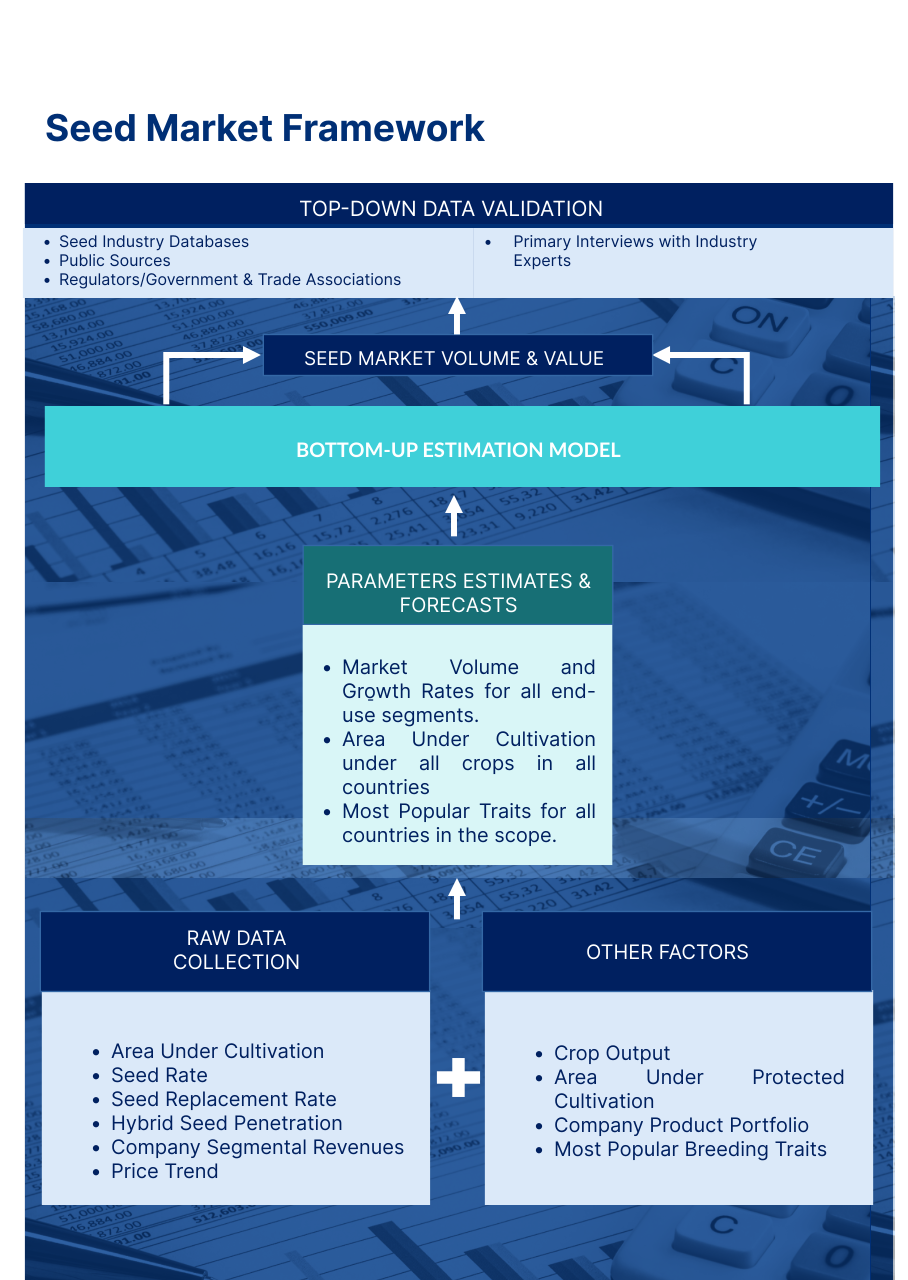
연구 방법론에 대한 자세한 내용을 확인하세요
PDF 다운로드